Price, as they say, is determined on the margins. This is especially true for inelastic goods. If 100 Tickle Me Elmo dolls exist in Walmart on Christmas eve, and 100 people absolutely need to have them, you don't have a problem. The price will be some reasonable markup on the cost of production. However, if one more person walks in fearing the wrath of his child if there's no Elmo under the tree, Walmart (WMT) can quickly turn into a war zone. In Walmart, this supply shortage might be settled by shoving and hair pulling. In a civilized market, this supply, demand inequity is settled with price. In the case of Elmo in 1996, some dolls were reportedly sold in aftermarkets for $1500.
This is an important concept to keep in mind when evaluating the silver market. Silver is interesting because it is actually two different markets. On one hand, silver is a physical commodity that is used in industry or warehoused as physical savings. This market is rather inelastic on the supply and demand side as I will discuss in a bit. On the other hand is the silver derivatives market, paper contracts for silver, that set the spot price on the margins. The paper market is elastic and depends more on investor psychology than underlying fundamentals.
First the physical market. Each year, new silver is dug out of the ground and added to supply. A higher silver price causes an increase in silver production, but that increase is constrained due to the time it takes to bring new production on line and the fact that 70% of silver production comes as a relatively small byproduct of mining other metals. Government sales and recycling added about 25% to the physical supply in 2010, but those factors are only loosely correlated with price.
On the demand side, industrial applications make up nearly half of the demand. For many of these applications, such as electronics, coatings, anti-microbial uses, etc., the amount of silver in the final product is a tiny fraction of the product cost, thus a rise in the silver price does not affect its usage. For demand components such as jewelry, coins, and physical bar investment, a rising price can actually add to the desirability of these goods. As such, the supply and demand of physical silver is very insensitive to price as I explain further in my article, "The Top 10 Reasons Silver Will Soar".
Now for the paper market. Like all commodity futures markets, the silver futures market has its roots in providing a legitimate market function. A silver miner, for instance, may sell futures to lock in prices and pay for capital equipment. On the other side of the trade, an electronics manufacturer may buy futures to lock in their costs for silver they intend to use in the future. And like other commodities, the silver futures market provides speculators a convenient way to bet on the future price of silver without having to ship the stuff around. This speculation through commodities derivatives is not always a bad thing as it can add liquidity to markets and can help with price discovery.
But in the case of silver, the derivatives market has gotten way out of hand to the point of distorting true price discovery. Some market watchers believe there has been manipulation by banks with huge short positions, such as J.P. Morgan. Some, like Eric Sprott, suggest that the CME Group's odd behavior, such as raising margins two days after the silver price had just dropped by 22%, is holding down the price to help the commercial shorts. Regardless of whether you believe these "conspiracy" theories, in the long run, it does not matter. The important thing to realize is that the silver derivatives market, like all derivatives markets, is based on leverage, confidence and promises.
The main way the futures market keeps down the spot price of silver is by greatly adding to the supply of silver for investment. Take the example of the COMEX which currently has 102,516 open interest contracts (512 million ounces) promised for future delivery. This compares to roughly 117 million ounces of physical silver available for investment in 2010 (Mine supplies 736 + recycling 215 + gov't. sales 45 - fabrication 879 = 117Moz.) Shorts have promised to deliver over four times the amount of physical silver available per year. In other words, demand for silver investment at today's price is much higher than physical supply. This works fine as long as futures investors don't take physical delivery. Shorts can simply settle the contract for the cash value and everybody's happy. If a small amount of investors stand for delivery, the shorts can transfer silver from their accounts at the COMEX or buy silver on the open market. However, as more investors stand for physical delivery, things can get dicey.
Kyle Bass of Hayman Capital was clearly concerned about this leverage risk in the COMEX when he said the following:
29 January 2012

28 January 2012
Tail Events, Isolation, the New Normal
By: Jim Willie
The year 2012 has started out in strange ways. While celestial forces augur for rare tail events, the assurance of man-made events that stretch far into the extreme tail of probability are not only very likely but will be of a type to reflect the change in the global balance of financial power. The Paradigm Shift mentioned over the course of the last two to three years is at work, having moved into a higher gear. The gold is moving from the West to the East, along with the power. We will not see the process reverse in our lifetime. The sanctions set against Iran have been devised by a former global leader nation that is beset by insolvency, fraud, and lost integrity. The backfire has consolidated forces into a more fortified position against the USDollar. Trade increasingly is not being settled in US$ terms. The icons of the day are mere apologist public address systems attempting to rationalize and justify the deep insolvency and wrecked systems. The new normal is of a caravan file of broken cars and trucks sputtering down the road, using the false fuel of hyper monetary inflation and the offensive paint of phony financial accounting, the tell-tale sign being the ugly rancid smoke out of their tailpipes. The last insult is of the US Presidential election process, which is badly marred by obvious inconsistencies and anomalies. The vote count for the candidate that attracts the biggest crowds, attracts the biggest donations from corporations, and defies the financially teetering system does not match the final official tallies.
Prepare for the Rare Damage of Tail Events
In the probability world, a tail event is described as an occurrence far out in the small numbers of probability, extended on the tail of the curve of likelihood. In the quality control domain, the battle cry used to be Six Sigma, meaning the tolerated defect rate goal would be six standard errors, a rate in no way achievable. A quick check of the probability tables unmasks the lofty goal as one defect part off the assembly line in every 1.013 billion items. That is Six Sigma on the normal bell-shaped curve. However, in the world of phony finagled finance, such rare events are indeed occurring. The modern world has never seen such grotesque charred ramparts posing as financial structures, badly beset by the insolvency caused by the natural sequence of broken asset bubbles, aggravated by absent industry. In fact, the entire fiat currency system, where money is nothing but redefined debt, is an abomination destined for the ruin we see on such a tragic widespread level. The modern world has never seen such grotesque housing disasters, the dream of home ownership turned upside down, one quarter of American households owing more than the value of their homes. In fact, the entire housing dependence devised by Greenspan, where the USEconomy would lean not on industry but on rising home equity, serves as the calling card of central bank heresy. The heresy continues with the high priest ZIRP and bishop QE. Of course it ended in tears. The modern world has never seen such grotesque quicksand in sovereign debt for so many major nations. This goes far beyond Greece, Ireland, and Portugal, the symbols of small fry nations that few nations will make deep sacrifice for. In fact, as the sovereign debt spreads, it has become clear that Italy, Spain, France, and many other nations suffer from the sinking pressures that national securitized debt brings. As the sovereign debt loses value, the banking system sheds reserves valuation and goes insolvent, the credit engines stall, the economy falls into recession, the labor force loses jobs, the spending patterns falter, and the nation goes into a failure mode. See the Cauchy distribution in the graphic, which when the degrees of freedom grow unbounded, approaches the Gaussian normal.
 Some important tail events of rare type are coming. Any attempts to control a Greek Govt Bond default will be fraught with high risk and deep peril. The equal necessity to control a default for Ireland and Portugal will be made obvious. The extension to Italian and Spanish Govt Bond losses in collateral damage will be obvious. The implications to Credit Default Swaps must also be handled, not possible in the same fraudulent manner as before with redefinitions and denied insurance awards. The contagion of vanished equity in the banking system will spread to London, New York, and Germany, in whose nations numerous banks will fail. It will be extremely difficult for the USDollar to ward off such powerful storm damage, and remain as the global reserve currency. Some distant maritime voices might regard my claims as premature and far-fetched, but their preoccupation with gold basis has left their voices mere reverberant richochets in the hinterland. The academic voices seem out of touch with trends, the loud laps on the rocks from waves of inflation hardly recognized for their damage from the remote seacoast. They seem unable to foresee the new found land that is forming in the East, divorced from the USDollar.
Iran Sanctions Backfire into Isolation
In the last two weekly articles, the backfire was described regarding Iran sanctions, the response from the emerging economies, and the harmful effects of foreign nations grappling with defense from the uncontrollable unbridled unending printing of phony money. The USGovt actions have galvanized a response, led not by Iran but by China. The raft of bilateral accords juiced by currency swap agreements has provided a significant buoyancy in the global trade framework, a highly complex system. It dictates the flow of USDollars in obvious ways, but it also dictates the formation of reserve banking systems in more subtle ways. In 2007, when Brazil and China announced a swap facility to bypass the USDollar in trade settlement, the Jackass took notice like a prairie dog raising his head with erect spine. In 2010, when Russia and China announced a swap facility to bypass the USDollar in trade settlement, the Jackass took notice again. The big trade winds were changing direction. The extreme importance of trade and banking interwoven should not be overlooked, as often done by the clueless cast of US economists. So when in the last month, Japan and China announced a swap facility to bypass the USDollar in trade settlement, the Jackass concluded that the end was near for the waterlogged American financial fortress. These are two primary Asian powerhouses, who with South Korea form the core strength of the entire East.
The USDollar might not be attacked on several fronts with harsh assaults so much as it will be relegated into irrelevance, as the USDollar will be ignored and left to defend itself in the open fields where wolves and dragons roam wild. Note the parallel to the COMEX, which as a market will also be relegated into irrelevance, as the precious metals will be traded elsewhere, in markets where private accounts are not stolen. Entire Compliance Departments have forbidden usage of the COMEX as of January, due to outlaws overrunning the floors. As the USEconomy is isolated, it will be compelled to bid up whatever foreign currency is required to purchase commodities and finished products. In reaction, the USDollar will fall in value.
The year 2012 has started out in strange ways. While celestial forces augur for rare tail events, the assurance of man-made events that stretch far into the extreme tail of probability are not only very likely but will be of a type to reflect the change in the global balance of financial power. The Paradigm Shift mentioned over the course of the last two to three years is at work, having moved into a higher gear. The gold is moving from the West to the East, along with the power. We will not see the process reverse in our lifetime. The sanctions set against Iran have been devised by a former global leader nation that is beset by insolvency, fraud, and lost integrity. The backfire has consolidated forces into a more fortified position against the USDollar. Trade increasingly is not being settled in US$ terms. The icons of the day are mere apologist public address systems attempting to rationalize and justify the deep insolvency and wrecked systems. The new normal is of a caravan file of broken cars and trucks sputtering down the road, using the false fuel of hyper monetary inflation and the offensive paint of phony financial accounting, the tell-tale sign being the ugly rancid smoke out of their tailpipes. The last insult is of the US Presidential election process, which is badly marred by obvious inconsistencies and anomalies. The vote count for the candidate that attracts the biggest crowds, attracts the biggest donations from corporations, and defies the financially teetering system does not match the final official tallies.
Prepare for the Rare Damage of Tail Events
In the probability world, a tail event is described as an occurrence far out in the small numbers of probability, extended on the tail of the curve of likelihood. In the quality control domain, the battle cry used to be Six Sigma, meaning the tolerated defect rate goal would be six standard errors, a rate in no way achievable. A quick check of the probability tables unmasks the lofty goal as one defect part off the assembly line in every 1.013 billion items. That is Six Sigma on the normal bell-shaped curve. However, in the world of phony finagled finance, such rare events are indeed occurring. The modern world has never seen such grotesque charred ramparts posing as financial structures, badly beset by the insolvency caused by the natural sequence of broken asset bubbles, aggravated by absent industry. In fact, the entire fiat currency system, where money is nothing but redefined debt, is an abomination destined for the ruin we see on such a tragic widespread level. The modern world has never seen such grotesque housing disasters, the dream of home ownership turned upside down, one quarter of American households owing more than the value of their homes. In fact, the entire housing dependence devised by Greenspan, where the USEconomy would lean not on industry but on rising home equity, serves as the calling card of central bank heresy. The heresy continues with the high priest ZIRP and bishop QE. Of course it ended in tears. The modern world has never seen such grotesque quicksand in sovereign debt for so many major nations. This goes far beyond Greece, Ireland, and Portugal, the symbols of small fry nations that few nations will make deep sacrifice for. In fact, as the sovereign debt spreads, it has become clear that Italy, Spain, France, and many other nations suffer from the sinking pressures that national securitized debt brings. As the sovereign debt loses value, the banking system sheds reserves valuation and goes insolvent, the credit engines stall, the economy falls into recession, the labor force loses jobs, the spending patterns falter, and the nation goes into a failure mode. See the Cauchy distribution in the graphic, which when the degrees of freedom grow unbounded, approaches the Gaussian normal.
Iran Sanctions Backfire into Isolation
In the last two weekly articles, the backfire was described regarding Iran sanctions, the response from the emerging economies, and the harmful effects of foreign nations grappling with defense from the uncontrollable unbridled unending printing of phony money. The USGovt actions have galvanized a response, led not by Iran but by China. The raft of bilateral accords juiced by currency swap agreements has provided a significant buoyancy in the global trade framework, a highly complex system. It dictates the flow of USDollars in obvious ways, but it also dictates the formation of reserve banking systems in more subtle ways. In 2007, when Brazil and China announced a swap facility to bypass the USDollar in trade settlement, the Jackass took notice like a prairie dog raising his head with erect spine. In 2010, when Russia and China announced a swap facility to bypass the USDollar in trade settlement, the Jackass took notice again. The big trade winds were changing direction. The extreme importance of trade and banking interwoven should not be overlooked, as often done by the clueless cast of US economists. So when in the last month, Japan and China announced a swap facility to bypass the USDollar in trade settlement, the Jackass concluded that the end was near for the waterlogged American financial fortress. These are two primary Asian powerhouses, who with South Korea form the core strength of the entire East.
The USDollar might not be attacked on several fronts with harsh assaults so much as it will be relegated into irrelevance, as the USDollar will be ignored and left to defend itself in the open fields where wolves and dragons roam wild. Note the parallel to the COMEX, which as a market will also be relegated into irrelevance, as the precious metals will be traded elsewhere, in markets where private accounts are not stolen. Entire Compliance Departments have forbidden usage of the COMEX as of January, due to outlaws overrunning the floors. As the USEconomy is isolated, it will be compelled to bid up whatever foreign currency is required to purchase commodities and finished products. In reaction, the USDollar will fall in value.
Friday Fraud Transitioning Into Friday Perfection
Now for the good stuff. Below is a 1-yr daily chart of the price of gold. Those of you who are familiar with doing technical analysis on stock charts will recognize this particular chart as being nothing less than bull market full-on chart pornography. When gold breaks above $1800, we will really be off to the races. I think gold is going to make some moves to the upside that will shock most gold bears and surprise many bulls.


Living In A QE World
By James Bianco - January 27th, 2012, 8:15AM
All Central Bank Balance Sheets Are Exploding Higher, Or Engaged In QE
The degree to which central banks around the world are printing money is unprecedented.
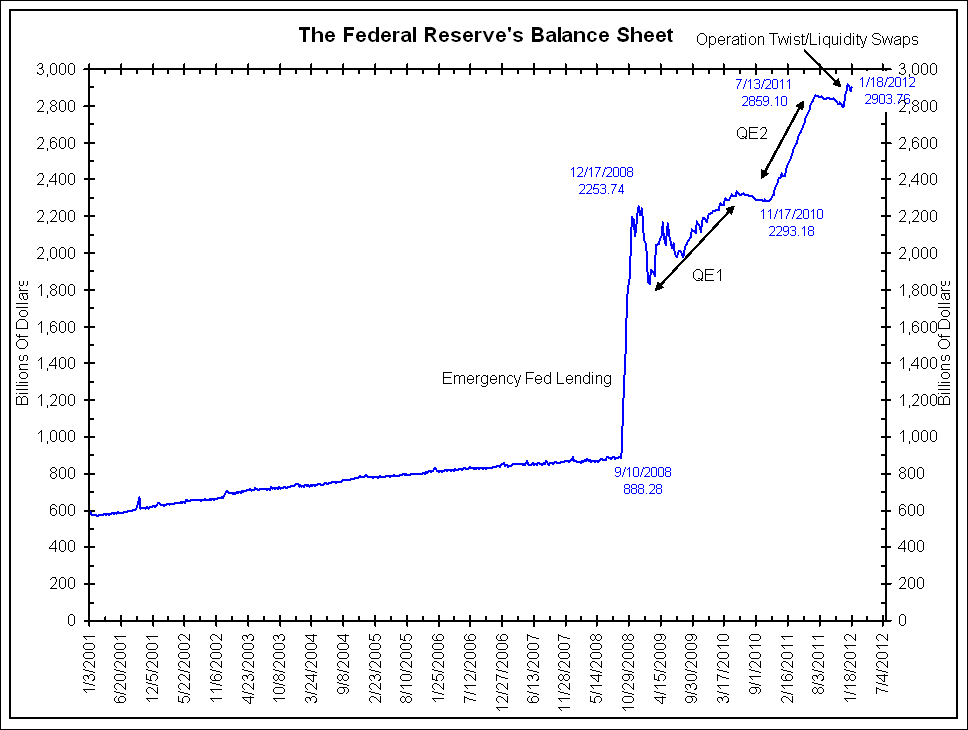
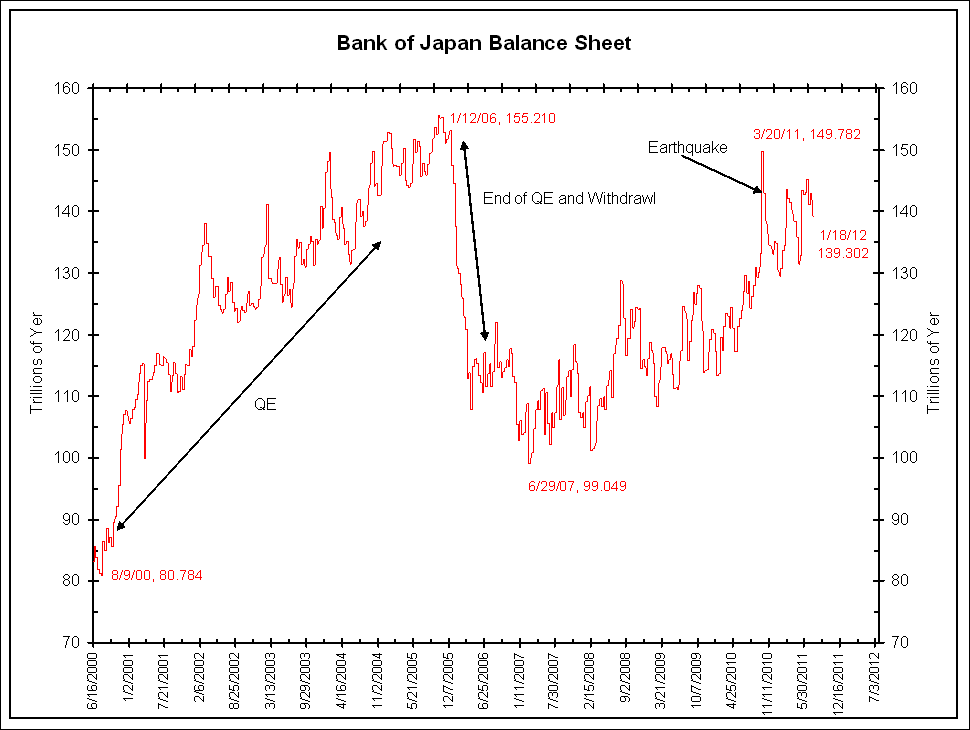
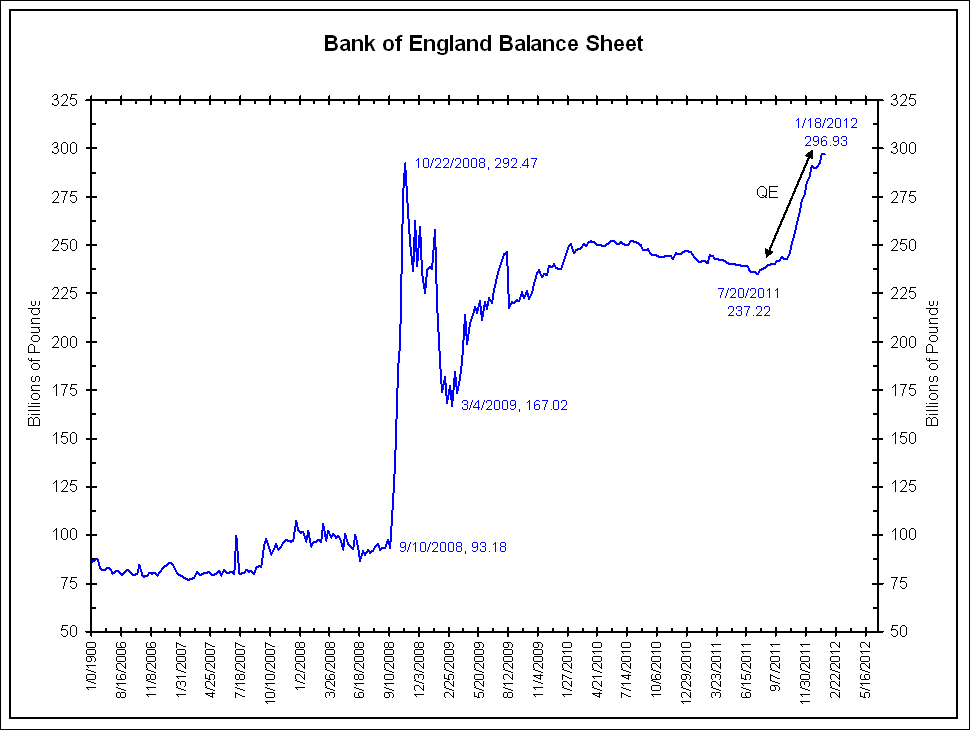
The first eight charts below show the balance sheets of the largest central banks in the world. They are the European Central Bank (ECB), the Federal Reserve (Fed), the Bank of Japan (BoJ), the Bank of England (BoE), the Bundesbank (Germany), the Banque de France, the People’s Bank of China (PBoC) and the Swiss National Bank (SNB). Noted on the charts are significant events or growth rates.
Shown is the size of each respective balance sheet in its local currency. Note that all are exploding higher as every chart goes from the lower left to the upper right. Most are still making new all-time highs. If the basic definition of quantitative easing (QE) is a significant increase in a central bank’s balance sheet via increasing banking reserves, then all eight of these central banks are engaged in QE.
>
Click to enlarge:

˜˜˜

˜˜˜

˜˜˜

The degree to which central banks around the world are printing money is unprecedented.
The first eight charts below show the balance sheets of the largest central banks in the world. They are the European Central Bank (ECB), the Federal Reserve (Fed), the Bank of Japan (BoJ), the Bank of England (BoE), the Bundesbank (Germany), the Banque de France, the People’s Bank of China (PBoC) and the Swiss National Bank (SNB). Noted on the charts are significant events or growth rates.
Shown is the size of each respective balance sheet in its local currency. Note that all are exploding higher as every chart goes from the lower left to the upper right. Most are still making new all-time highs. If the basic definition of quantitative easing (QE) is a significant increase in a central bank’s balance sheet via increasing banking reserves, then all eight of these central banks are engaged in QE.
>
Click to enlarge:

˜˜˜
˜˜˜
˜˜˜
Is the Fed Cranking Up the Presses Again?
Dear Reader,
Vedran Vuk here, filling in for David Galland. Today we'll cover a number of topics, most importantly Bud Conrad's coverage of the Fed's announcement on Wednesday. For a while, investors were basically allowed to sleep through these Federal Open Market Committee statements – we get it; they're keeping rates low. However, this meeting had a few key points that should stir investors from their slumber. I'll start with a discussion about the weakening core of European nations. Then I'll return to touch on other topics of interest.
By Vedran Vuk, Senior Analyst
While the euro crisis has taken a momentary breather, let's not forget the even bigger dangers on the horizon. We've all seen the spreads between the PIIGS and German bonds. Needless to say, they aren't pretty. But another chart is scaring me even more at the moment: It's the 10-year bond spread between Germany and France:

That should come as no surprise. The rest of Europe has been following the exact same path as Greece, Portugal, Spain, and all the other "bad guys." It's the same story of excessive spending programs, disastrous labor laws, and widespread government interventions. In fact, the European core must necessarily experience the same problems. If you're following the same stupid policies, you should expect the same bad results. It's logically inconsistent to think that certain policies are absolute failures in Greece while they magically work in France.
The only difference is that the core countries have been able to afford their programs thus far. Countries such as Greece aren't following a unique Greek policy agenda. Instead, Greece essentially tried to mimic Western European policies on an Eastern European budget. Unfortunately, that just doesn't work… but those policies won't work for Western Europe in the long run either.
Now don't get me wrong: I'm not saying that France or some of the other core countries are going into a crisis. I'm just pointing out that the cracks are starting show. If Europe can't shake its obsession with the welfare state, I have little doubt that some of the biggest European countries will be the PIIGS of tomorrow. They're walking the same path as Greece, Ireland, Italy, and Portugal. But because of their stronger economies, they are taking this stroll at a much slower pace while the PIIGS are sprinting toward the end of the road… and the cliff waiting there. Though one country is running for the cliff and the other is walking, make no mistake – they're both on the exact same path.
But let's put this in perspective for now. The spread over German bonds is a little above one percent. This isn't the end of the world. In fact, it's very far from it, and considering all the problems in Europe, I'd still much rather hold French bonds than many other options. However, there are a few important things to take away from this situation. The spread between French and German bonds can teach us an important lesson about US interest rates.
Vedran Vuk here, filling in for David Galland. Today we'll cover a number of topics, most importantly Bud Conrad's coverage of the Fed's announcement on Wednesday. For a while, investors were basically allowed to sleep through these Federal Open Market Committee statements – we get it; they're keeping rates low. However, this meeting had a few key points that should stir investors from their slumber. I'll start with a discussion about the weakening core of European nations. Then I'll return to touch on other topics of interest.
Cracks in the European Core
By Vedran Vuk, Senior AnalystWhile the euro crisis has taken a momentary breather, let's not forget the even bigger dangers on the horizon. We've all seen the spreads between the PIIGS and German bonds. Needless to say, they aren't pretty. But another chart is scaring me even more at the moment: It's the 10-year bond spread between Germany and France:

(Click on image to enlarge)
The media always want to frame financial news in the classical sense: the good guys versus the bad guys. In this case, it's the responsible and prudent core of Europe versus the lazy and uncontrollable PIIGS. However, the chart above tells a different story. The crisis has reached the core itself. Rather than being an impenetrable fortress, countries such as France have their own problems.That should come as no surprise. The rest of Europe has been following the exact same path as Greece, Portugal, Spain, and all the other "bad guys." It's the same story of excessive spending programs, disastrous labor laws, and widespread government interventions. In fact, the European core must necessarily experience the same problems. If you're following the same stupid policies, you should expect the same bad results. It's logically inconsistent to think that certain policies are absolute failures in Greece while they magically work in France.
The only difference is that the core countries have been able to afford their programs thus far. Countries such as Greece aren't following a unique Greek policy agenda. Instead, Greece essentially tried to mimic Western European policies on an Eastern European budget. Unfortunately, that just doesn't work… but those policies won't work for Western Europe in the long run either.
Now don't get me wrong: I'm not saying that France or some of the other core countries are going into a crisis. I'm just pointing out that the cracks are starting show. If Europe can't shake its obsession with the welfare state, I have little doubt that some of the biggest European countries will be the PIIGS of tomorrow. They're walking the same path as Greece, Ireland, Italy, and Portugal. But because of their stronger economies, they are taking this stroll at a much slower pace while the PIIGS are sprinting toward the end of the road… and the cliff waiting there. Though one country is running for the cliff and the other is walking, make no mistake – they're both on the exact same path.
But let's put this in perspective for now. The spread over German bonds is a little above one percent. This isn't the end of the world. In fact, it's very far from it, and considering all the problems in Europe, I'd still much rather hold French bonds than many other options. However, there are a few important things to take away from this situation. The spread between French and German bonds can teach us an important lesson about US interest rates.
If The Economy Is Improving….
 Everywhere you turn these days, someone is proclaiming that the economy is improving. Barack Obama is endlessly touting the "improvement" in the economy, the mainstream media is constantly talking about "the economic recovery" and an increasing number of Americans seem to be buying into this line of thinking. A new NBC/Wall Street Journal poll found that 37 percent of Americans believe that the economy will improve over the next year, while only 17 percent of Americans believe that it will get worse. But is the economy actually improving? Not really. At the moment things are relatively stable. Some economic statistics are improving slightly and some continue to get even worse. However, it is very important to keep in mind that one of the biggest reasons why things have stabilized is because the federal government is pumping more than a trillion dollars a year into the economy that it does not have. The Obama administration is engaging in a debt binge unlike anything America has ever seen before, and yet many economic indicators are still in decline. So what is going to happen when the federal government stops injecting gigantic waves of borrowed money into the economy? That is a frightening thing to think about. The best efforts of our "leaders" in Washington D.C. are not accomplishing a whole lot. The Federal Reserve has pushed interest rates as low as they can go and the federal government is spending unprecedented amounts of money. But even with the federal government and the Federal Reserve pushing the accelerator all the way to the floor, the economy is still not improving much at all. Millions upon millions of Americans out there are anticipating some sort of a "great economic recovery", and they are going to be bitterly disappointed.
But right now there are some "bright spots" in the economy, and you are bound to run into family and friends that will repeat to you the nonsense that they are hearing on the television about how the economy is recovering.
When they try to convince you that the economy is getting better, ask them these questions....
If the economy is getting better, then why did new home sales in the United States hit a brand new all-time record low during 2011?
If the economy is getting better, then why are there 6 million less jobs in America today than there were before the recession started?
It's Only $1.2 Trillion, So No U.S. Treasury Press Release
Friday, January 27, 2012 - 16:02 - By Denny Gulino
WASHINGTON (MNI) - The hour has almost arrived for an important bookeeping entry at the U.S. Treasury Department, the notation that from this day forward the U.S. government can borrow another $1.2 trillion.
Don't look in your inbox for that email from Treasury alerting the world at the close-of-business trigger time. There won't be any, the department said.
Such is the charged political atmosphere in Washington in a presidential election year, the White House appears not to want to again remind anyone of the huge amount of borrowing that is routinely necessary to keep government operating. And Republicans apparently do not want to again showcase the fact there is nothing they can do about it.
Neither side has hesitated in the past when they want to trumpet their battles, stick to their positions and fight to almost their last breath about whether the country should pay its bills. Standard & Poor's memorialized that kind of intransigence late last year, awarding Congress the blame for the first downgrade of U.S. sovereign debt.
Getting past that Capitol Hill trench warfare meant both sides reluctantly agreeing to a short-term fix to the paralysis over further borrowing. In three steps the White House would get its borrowing power, enough to last past the election into early 2013. The third step is Friday's quiet $1.2 trillion that will show up on the daily report of Treasury cash balances Monday.
WASHINGTON (MNI) - The hour has almost arrived for an important bookeeping entry at the U.S. Treasury Department, the notation that from this day forward the U.S. government can borrow another $1.2 trillion.
Don't look in your inbox for that email from Treasury alerting the world at the close-of-business trigger time. There won't be any, the department said.
Such is the charged political atmosphere in Washington in a presidential election year, the White House appears not to want to again remind anyone of the huge amount of borrowing that is routinely necessary to keep government operating. And Republicans apparently do not want to again showcase the fact there is nothing they can do about it.
Neither side has hesitated in the past when they want to trumpet their battles, stick to their positions and fight to almost their last breath about whether the country should pay its bills. Standard & Poor's memorialized that kind of intransigence late last year, awarding Congress the blame for the first downgrade of U.S. sovereign debt.
Getting past that Capitol Hill trench warfare meant both sides reluctantly agreeing to a short-term fix to the paralysis over further borrowing. In three steps the White House would get its borrowing power, enough to last past the election into early 2013. The third step is Friday's quiet $1.2 trillion that will show up on the daily report of Treasury cash balances Monday.
Episode 242
In this episode, Max Keiser and co-host, Stacy Herbert, discuss the State of the Banana Republic, the blowout at Apple with its profits “trapped” overseas and the gloomy State of the Stiff Upper Lip as UK family debts soar by nearly 50%. And, finally, Max and Stacy examine a proposal that bankers like Goldman Sachs’ Lloyd Blankfein and JP Morgan's Jamie Dimon, should compete like strippers on the open job market.
Portugal 10 yr bond at 15%/Private PSI deal in Greece a non starter/USA raises debt ceiling to 16.4 trillion

Good evening Ladies and Gentlemen;
Gold closed up today for the second straight day to the tune of $26.50 to finish the comex session at $1726.30. Silver followed her older and wiser cousin by 61 cents to $33.70. Today is options expiry so this day had saw some early resistance from the bankers but not much. Gold and silver are being viewed as a safe haven with all the noise of sovereign defaults. Today Portugal saw its 10 yr bond rise above 15% signalling that it too will join Greece in bankruptcy momentarily. Japan for the first time saw a trade deficit as the nuclear damage is certainly having an effect on their economy.
Let us now head over to the comex and assess trading, inventory movements and amounts of metal standing.
The total gold comex OI fell by 7965 contracts despite gold's big advance. Many bankers jumped ship with the news yesterday that the USA Fed policy is for ZIRP to continue to 2014. As far as I am concerned, it will continue to infinity. The front options expiry month of January saw its OI rise by 51 contracts despite only 1 delivery notice yesterday. We thus gained 50 contracts or 5000 oz of additional gold standing. The front delivery month of February saw its OI contract from 121,002 to 110,512 as all of these players rolled into April. The estimated volume today was a monstrous 316,070 contracts. The confirmed volume yesterday was also huge at 323,392. It seems that many are trying to locate as much physical as possible.
The total silver comex OI certainly did not follow in the footsteps of its older and wiser cousin, gold. Here the OI fell by 509 contracts from 103,025 to 102,516 despite the huge advance in silver yesterday and today. It looks like we had a few post-mortems for our bankers today. The front options expiry month of January saw its OI rise by 43 contracts despite 34 delivery notices. Thus 77 contracts or 385,000 additional oz of silver are standing in January. The next big delivery month is March and here we saw the OI remain relatively constant at 51,142 dropping by a little less than 500 contracts. The estimated volume today was very weak at 37,154. The confirmed volume yesterday was a lot better coming in at 55,886.
I have been telling you that the silver comex has been trading differently to gold for at least the last 3 months.
It seems that the high frequency traders are almost the entire volume at the comex and these guys are nothing but day traders. Thus silver can move in monstrous directions as the remaining longs are by definition are strong in nature and cannot be suckered into selling. The other issue is that Butler believes now that JPMorgan is now liquidating its short position and will soon be going long. This will be the end game as nobody will supply the paper short.
(courtesy ted Butler from his paid subscription. Special thanks to Ted and Ed Steer)
"If JPMorgan is not selling but is, in fact, buying, then a very different scenario could develop, similar to how I have speculated in the past. If JPMorgan is buying and not the technical funds, then a very different and bullish scenario emerges. If JPMorgan decides not to put its head back into the lion’s mouth and withdraws from manipulating silver, then a new silver chapter may have begun. Let me be clear – there is no way of determining for sure who is buying and selling today and this past Friday; only future COTs will reveal that. If it turns out that JPMorgan is buying back more of its short position on these rallies that would suggest much higher prices to come and maybe real soon. This goes to the heart of the silver manipulation. Take away the big silver short and you should take away the manipulation itself. I’m not saying that is the case, just that it might be. I would play it, as I always do, like it may be the end of the manipulat ion, simply because if it is, there will be little likelihood of second chances to get on board easily."
"That’s not to say that the commercials will roll over and play dead. I sense a profound lack of true liquidity since the MF Global disaster, in which the HFT operators are now responsible for an even higher share of total volume than before. I think that the HFT share of silver volume has approached 100% at times recently, rendering the silver market to its most illiquid state in my experience. More than anything else, this low true liquidity environment is behind the price spikes of Friday and today. In such a low liquidity environment we must be prepared for more price volatility, not less. We must be prepared for whatever may come, but we must also hang on to silver positions like never before. Be prepared for volatility that will rattle your bones. But volatility is a two-way street and up is one of the ways. So is up big."
end
Volcker confirms central bank need to suppress gold to stabilize exchange rates at 'critical point'
Submitted by cpowell on Thu, 2012-01-26 20:50. Section: Daily Dispatches
2:09p ET Thursday, January 26, 2012
Dear Friend of GATA and Gold:
Former Federal Reserve Chairman Paul Volcker today defended government intervention in the gold market to counter "exchange rate instability at a critical point."
Volcker's comments came in response to inquiry from the German freelance journalist Lars Schall, who noted GATA's reference to Volcker's expression of regret, recorded in his memoirs, about the failure of Western central banks to intervene to suppress gold prices during a currency revaluation in 1973. Volcker's support of gold price suppression was cited by your secretary/treasurer in his address to the Vancouver Resource Investment Conference last Saturday:
http://www.gata.org/node/10909
In his comments to Schall today, Volcker added that, "to the best of my knowledge," the United States has not intervened in the gold market for more than 40 years.
Nevertheless, the former Fed chairman confirmed the profound interest central banks have in the price of gold because of its effect on the currency markets, an interest that may justify intervention at any "critical point."
This contradicts oft-repeated assertions by certain gold market analysts, like Kitco's Jon Nadler, that central banks have no interest in manipulating the gold market:
http://www.gata.org/node/8717
Schall's initiative demonstrates what is so lacking in the mainstream financial media. He tracked down a central banker, put the gold price manipulation question to him, and got a noteworthy answer on the record -- a feat not yet attempted by, for example, the Financial Times, The Wall Street Journal, The New York Times, Reuters, Bloomberg News, the Associated Press, and on and on.
Imagine the news that might result from persistent questioning of central bankers in public about market intervention. Of course that's exactly why it's seldom done or permitted.
Schall's account of his search for Volcker is appended.
2:09p ET Thursday, January 26, 2012
Dear Friend of GATA and Gold:
Former Federal Reserve Chairman Paul Volcker today defended government intervention in the gold market to counter "exchange rate instability at a critical point."
Volcker's comments came in response to inquiry from the German freelance journalist Lars Schall, who noted GATA's reference to Volcker's expression of regret, recorded in his memoirs, about the failure of Western central banks to intervene to suppress gold prices during a currency revaluation in 1973. Volcker's support of gold price suppression was cited by your secretary/treasurer in his address to the Vancouver Resource Investment Conference last Saturday:
http://www.gata.org/node/10909
In his comments to Schall today, Volcker added that, "to the best of my knowledge," the United States has not intervened in the gold market for more than 40 years.
Nevertheless, the former Fed chairman confirmed the profound interest central banks have in the price of gold because of its effect on the currency markets, an interest that may justify intervention at any "critical point."
This contradicts oft-repeated assertions by certain gold market analysts, like Kitco's Jon Nadler, that central banks have no interest in manipulating the gold market:
http://www.gata.org/node/8717
Schall's initiative demonstrates what is so lacking in the mainstream financial media. He tracked down a central banker, put the gold price manipulation question to him, and got a noteworthy answer on the record -- a feat not yet attempted by, for example, the Financial Times, The Wall Street Journal, The New York Times, Reuters, Bloomberg News, the Associated Press, and on and on.
Imagine the news that might result from persistent questioning of central bankers in public about market intervention. Of course that's exactly why it's seldom done or permitted.
Schall's account of his search for Volcker is appended.
Fear Index shows that gold is undervalued
2012-JAN-24
James Turk has been writing about the Fear Index for years, as you can see in James Turk’s Free Gold Money Report.
 The year 2011 ended on a very weak note for the price of gold, which tested support near the lowest levels since August as the precious metal slid below $1,550. This movement even drove the GoldMoney Fear Index below 3% as US M3 continued to rise, surpassing $14.4 Trillion. The downward path of gold since the September highs immediately prompted cries that the "bubble was bursting" from every corner of the financial press.
They could not be more wrong.
Neither a rising price, nor anecdotal reports of increased buying are in any way proper evidence of a bubble. If we ignore the chatter and actually look at empirical data, it is quite easy to recognise a speculative bubble or mania. That is to say, an irrational and unsustainable overvaluation of an asset regardless of fundamentals, reinforced by the belief that it will continue to rise indefinitely. We have a number of very vivid examples in living memory: the dotcom bubble, the housing bubble, and history provides many more examples, John Law's Mississippi Bubble being the classic example.
A strict definition of a speculative bubble will therefore have two basic parts to it:
1. Irrational overvaluation. 2. Mass participation.
It is not enough for prices to go up, they must go up beyond what is justified by value. There must also be a psychological "herd" effect. If only a small minority takes part, it is difficult for a self-reinforcing feedback loop to happen. We've already explained how participation in the gold market remains the province of a tiny minority, even including all the "paper gold" instruments.
The importance of the GoldMoney Fear Index lies in answering the first question: What is the value of gold? As we've said before gold must be compared to its peers- other forms of money- in this case the US Dollar.
 The chart's message is powerful, the amount of dollars in circulation is still huge compared to the amount of gold that used to, barely 40 years ago, back them and give them the credibility necessary to become the world's reserve currency.
James Turk has been writing about the Fear Index for years, as you can see in James Turk’s Free Gold Money Report.
The year 2011 ended on a very weak note for the price of gold, which tested support near the lowest levels since August as the precious metal slid below $1,550. This movement even drove the GoldMoney Fear Index below 3% as US M3 continued to rise, surpassing $14.4 Trillion. The downward path of gold since the September highs immediately prompted cries that the "bubble was bursting" from every corner of the financial press.They could not be more wrong.
Neither a rising price, nor anecdotal reports of increased buying are in any way proper evidence of a bubble. If we ignore the chatter and actually look at empirical data, it is quite easy to recognise a speculative bubble or mania. That is to say, an irrational and unsustainable overvaluation of an asset regardless of fundamentals, reinforced by the belief that it will continue to rise indefinitely. We have a number of very vivid examples in living memory: the dotcom bubble, the housing bubble, and history provides many more examples, John Law's Mississippi Bubble being the classic example.
A strict definition of a speculative bubble will therefore have two basic parts to it:
1. Irrational overvaluation. 2. Mass participation.
It is not enough for prices to go up, they must go up beyond what is justified by value. There must also be a psychological "herd" effect. If only a small minority takes part, it is difficult for a self-reinforcing feedback loop to happen. We've already explained how participation in the gold market remains the province of a tiny minority, even including all the "paper gold" instruments.
The importance of the GoldMoney Fear Index lies in answering the first question: What is the value of gold? As we've said before gold must be compared to its peers- other forms of money- in this case the US Dollar.
Central-Bank Gold: Joining the Dots
By: Adrian Ash | Fri, Jan 27, 2012
Yes, central banks are holding more gold. But they're holding very much more wood-pulp on top...
The gold price on Wednesday broke up through the downtrend starting at last summer's record high. Or so a technical analyst studying the price chart would tell you.
But just as in late 2007 - from where gold began a 55% run inside 6 months - this week the price of gold bullion jumped on news that is fundamental: the price of money, specifically Dollars, the world's #1 currency for trade and central-bank reserves.
Back in 2007, the catalyst came as a baby-step rate cut of 0.25%, signaling the Fed's switch from raising to destroying the returns paid on cash savings. Now the Fed's new zero-rate promise "took gold comfortably clear of the 50, 100 and 200-day moving averages, and opened up some big targets to the upside," says one London technician. The previous ceiling of $1700 has become a support level according to bullion bank Scotia Mocatta, "with further key support at the 200-day moving average at $1645."
Whatever you make of such numbers, it's worth stepping back to see the wood for the trees. Because the trend in who's buying gold, and why, is so plain to spot that you hardly need join the dots.
Gold bullion holdings amongst the world's central banks, for instance, have risen to a 6-year high, according to data compiled by the International Monetary Fund. Emerging and developing nations have swollen their gold reserves 25% by weight since 2008. The debt-heavy West is a net seller, but only just.

The gold price on Wednesday broke up through the downtrend starting at last summer's record high. Or so a technical analyst studying the price chart would tell you.
But just as in late 2007 - from where gold began a 55% run inside 6 months - this week the price of gold bullion jumped on news that is fundamental: the price of money, specifically Dollars, the world's #1 currency for trade and central-bank reserves.
Back in 2007, the catalyst came as a baby-step rate cut of 0.25%, signaling the Fed's switch from raising to destroying the returns paid on cash savings. Now the Fed's new zero-rate promise "took gold comfortably clear of the 50, 100 and 200-day moving averages, and opened up some big targets to the upside," says one London technician. The previous ceiling of $1700 has become a support level according to bullion bank
Scotia Mocatta, "with further key support at the 200-day moving average at $1645."Whatever you make of such numbers, it's worth stepping back to see the wood for the trees. Because the trend in who's buying gold, and why, is so plain to spot that you hardly need join the dots.
Gold bullion holdings amongst the world's central banks, for instance, have risen to a 6-year high, according to data compiled by the International Monetary Fund. Emerging and developing nations have swollen their gold reserves 25% by weight since 2008. The debt-heavy West is a net seller, but only just.
Prepare for Greece to Leave Eurozone; German Government Calls for Greece to Cede Sovereignty Over Tax and Spending Decisions to Eurozone "Budget Commissioner"; Text of the German Demands
MISH'S
Global Economic
Trend Analysis
Prepare for Greece to exit the Eurozone. Germany has made a request that in my opinion practically guarantees that outcome. The Financial Times has a pair of articles on the matter but the conclusion above is mine.
German Government Calls for Greece to Cede Sovereignty to Eurozone "Budget Commissioner"
Please consider Call for EU to Control Greek Budget
The German government wants Greece to cede sovereignty over tax and spending decisions to a eurozone “budget commissioner” to secure a second €130bn bail-out, according to a copy of the proposal obtained by the Financial Times.
Global Economic
Trend Analysis
Prepare for Greece to exit the Eurozone. Germany has made a request that in my opinion practically guarantees that outcome. The Financial Times has a pair of articles on the matter but the conclusion above is mine.
German Government Calls for Greece to Cede Sovereignty to Eurozone "Budget Commissioner"
Please consider Call for EU to Control Greek Budget
The German government wants Greece to cede sovereignty over tax and spending decisions to a eurozone “budget commissioner” to secure a second €130bn bail-out, according to a copy of the proposal obtained by the Financial Times.
Greek Debt Solution Likely to Trigger Credit Default Swaps
MISH'S
Global Economic
Trend Analysis
European finance ministers and politicians have come to the conclusion that a deal, even one involving a credit event, is better than no deal at all. Thus it is increasingly likely the Greek Debt Wrangle will trigger credit default swaps.
Opposition to payouts on Greek credit-default swaps from European Union policy makers is softening as disputes over a voluntary debt exchange threaten to push the nation into default.
Any agreement between the Greek government and the Washington-based Institute of International Finance on debt writedowns will only bind 50 percent of investors in the 206 billion euros ($270 billion) of notes being negotiated, Barclays Capital estimates. Hedge funds may resist a deal, seeking to get paid in full or compensated from insurance contracts
“Politicians seem less concerned than before about CDS triggers,” said Michael Hampden-Turner, a credit strategist at Citigroup Inc. in London. “Having a payout on Greek CDS is probably better than the alternative: a loss in market faith of the product’s ability to provide a hedge against sovereign risk.”
Global Economic
Trend Analysis
European finance ministers and politicians have come to the conclusion that a deal, even one involving a credit event, is better than no deal at all. Thus it is increasingly likely the Greek Debt Wrangle will trigger credit default swaps.
Opposition to payouts on Greek credit-default swaps from European Union policy makers is softening as disputes over a voluntary debt exchange threaten to push the nation into default.
Any agreement between the Greek government and the Washington-based Institute of International Finance on debt writedowns will only bind 50 percent of investors in the 206 billion euros ($270 billion) of notes being negotiated, Barclays Capital estimates. Hedge funds may resist a deal, seeking to get paid in full or compensated from insurance contracts
“Politicians seem less concerned than before about CDS triggers,” said Michael Hampden-Turner, a credit strategist at Citigroup Inc. in London. “Having a payout on Greek CDS is probably better than the alternative: a loss in market faith of the product’s ability to provide a hedge against sovereign risk.”
SilverDoctors: Chris Duane Selling Everything But the Kitchen Sin...
SilverDoctors: Chris Duane Selling Everything But the Kitchen Sin...: Our friend Chris Duane from Dont-tread-on.me tells the Financial Survival Network that he is literally selling everything but the kitchen si...
SilverDoctors: Silver COT Report: Commercials Increase Silver Sho...
SilverDoctors: Silver COT Report: Commercials Increase Silver Sho...: The commercials increased their futures short position in silver by a net 4,639 contracts (23.2 million ounces) in the week ending 1/24/12. ...
The relationship between central banks and gold
By Richard ZimmermanGold seems to make fresh news headlines every day, and there is plenty of active desire to know the price. Like most commodities, that price is based upon changes in the forces of supply and demand. Gold is different: First because gold production is comparatively stable and unlikely to change much in the near future, and second because the supply and demand remains very liquid, although at times very sensitive and subject to rapid changes.
Much demand for gold characteristically comes from investors and buyers of gold jewelry. Investors frequently favor gold as a store of value during times of economic stress. There is another large holder of gold deposits: Central banks in their reserves. Let's review how much gold there is in central banks and what actions to expect by those who own it.
The role that central banks play is not always clear. They exist to manage a nation's currency. They perform this function by controlling their country's supply of money and thus influence interest rates by their actions. There are other tricks they can perform (quantitative easing comes to mind) but while they continue to own vast amounts of gold holdings, they do not use the gold standard any longer. Instead they maintain gold reserves as credibility, preferring to exchange currencies with one another. Do you remember the old axiom that "money doesn't grow on trees"? It doesn't; it gets created by central banks. The gold they hold is more of a backstop, or last line of defense.
What about that central bank gold; what do they do with it? In the currently financially stressed macro environment what actions might central banks take?
Summary
Even without the gold standard in force, gold still has retained an important function among central banks. It serves as a desirable backstop of last resort among global monetary reserves. Gold is exchangeable, and that quality keeps it the ultimate reserve currency, even among central banks. Decisions made by central banks influence money supply, relate to interest rates moves, and economic growth. Investors are now seeing financial stresses that make gold a desirable investment, even among other central banks. For now, expect European central banks to hang on to the gold they have. Meanwhile the entire available supplies of gold in the world, including all that is held privately is nothing when compared to the amounts of paper gold and underwritten risk in the global financial derivatives markets. But that's another story.
Much demand for gold characteristically comes from investors and buyers of gold jewelry. Investors frequently favor gold as a store of value during times of economic stress. There is another large holder of gold deposits: Central banks in their reserves. Let's review how much gold there is in central banks and what actions to expect by those who own it.
The role that central banks play is not always clear. They exist to manage a nation's currency. They perform this function by controlling their country's supply of money and thus influence interest rates by their actions. There are other tricks they can perform (quantitative easing comes to mind) but while they continue to own vast amounts of gold holdings, they do not use the gold standard any longer. Instead they maintain gold reserves as credibility, preferring to exchange currencies with one another. Do you remember the old axiom that "money doesn't grow on trees"? It doesn't; it gets created by central banks. The gold they hold is more of a backstop, or last line of defense.
What about that central bank gold; what do they do with it? In the currently financially stressed macro environment what actions might central banks take?
Summary
Even without the gold standard in force, gold still has retained an important function among central banks. It serves as a desirable backstop of last resort among global monetary reserves. Gold is exchangeable, and that quality keeps it the ultimate reserve currency, even among central banks. Decisions made by central banks influence money supply, relate to interest rates moves, and economic growth. Investors are now seeing financial stresses that make gold a desirable investment, even among other central banks. For now, expect European central banks to hang on to the gold they have. Meanwhile the entire available supplies of gold in the world, including all that is held privately is nothing when compared to the amounts of paper gold and underwritten risk in the global financial derivatives markets. But that's another story.
'The truth behind the silver market'
By Eric Sprott & David Baker
As we approach the end of 2011, the Silver spot price has admittedly endured a tougher road than we would have expected. And let's be honest -- what investment firm on Earth has pounded the table on silver harder than we have?
After the orchestrated silver sell-off in May 2011, silver promptly rose back to US$40/oz where it consolidated nicely, only to drop back below US$30 within a two-week span in late September.
The September sell-off was partly due to the market's disappointment over Bernanke's Operation Twist, which sounded interesting but didn't involve any real money printing. Like the May sell-off before it, however, it was also exacerbated by a seemingly needless 21% margin rate hike by the CME on Sept. 23, followed by a 20% margin hike by the Shanghai Gold Exchange -- the CME's counterpart in China, three days later.

The paper markets still dictate the spot market for physical gold and silver. When we talk about the "paper market," we're referring to any paper contract that claims to have an underlying link to the price of gold or silver, and we're referring to contracts that are almost always levered.
It's highly questionable today whether the paper market has any true link to the physical market for gold and silver, and the futures market is the most obvious and influential "paper market" offender.
When the futures exchanges like the CME hike margin rates unexpectedly, it's usually under the pretense of protecting the "integrity of the exchange" by increasing the collateral (money) required to hold a position, both for the long (future buyer) and the short (future seller). When they unexpectedly raise margin requirements two days after silver has already declined by 22%, however, who do you think that margin increase hurts the most? The long buyer, or the short seller?
By raising the margin requirement at the very moment the long contracts have already received an initial margin call (because the price of silver has dropped), they end up doubling the longs' pain -- essentially forcing them to sell their contracts. This in turn creates even more downward price pressure, and ends up exacerbating the very risks the margin hikes were allegedly designed to address.
When reviewing the performance of silver this year, it's important to acknowledge that nothing fundamentally changed in the physical silver market during the sell-offs in May or mid-September. In both instances, the sell-offs were intensified by unexpected margin rate hikes on the heels of an initial price decline.
It should also come as no surprise to readers that the "shorts" took advantage of the September sell-off by significantly reducing their silver short positions. Should physical silver be priced off these futures contracts? Absolutely not. That they have any relationship at all is somewhat laughable at this point.
But futures contracts continue to heavily influence spot prices all the same, and as long as the "longs" settle futures contracts in cash, which they almost always do, the futures market-induced whipsawing will likely continue.
It also serves to note that the class-action lawsuits launched against two major banks for Silver manipulation remain unresolved today, as does the ongoing CFTC investigation into silver manipulation, which has yet to bear any discernible results.
Meanwhile, despite the needless volatility triggered by the paper market, the physical market for silver has never been stronger. If the September sell-off proved anything, it's the simple fact that PHYSICAL buyers of silver are not frightened by volatility.
They view dips as buying opportunities, and they buy in size. During the month of September, the US Mint reported the second highest sales of physical silver coins in its history, with the majority of sales made in the last two weeks of the month.
Reports from India in early October indicated that physical silver demand had created short-term supply issues for physical delivery due to problems with airline capacity.
In China, which reportedly imported 264.69 tons (7.7 million oz) of silver in September alone, the volume of silver forward contracts on the Shanghai Gold Exchange was more than six times higher than the same period in 2010.
It was clear to anyone following the silver market that the physical demand for the metal actually increased during the paper price decline. And why shouldn't it? Have you been following Europe lately? Do the politicians and bureaucrats there give you confidence?
Gold and silver are the most rational financial assets to own in this type of environment because they are no one's liability. They are perfectly designed to protect us during these periods of extreme financial turmoil. And wouldn't you know it, despite the volatility, gold and silver have continued to do their job in 2011.
As we write this, in Canadian dollars, gold is up 23.4% on the year and silver's up 6.8%. Meanwhile, the S&P/TSX is down -12.3%, the S&P 500 is down -5.1% and the DJIA is up a mere +0.26%.
So here's the question: We think we understand the value and great potential in silver today, and we know that the buyers who bought in late September most definitely understand it... but do silver mining companies appreciate how exciting the prospects for silver are?
Do the companies that actually mine the metal out of the ground understand the demand fundamentals driving the price of their underlying product? Perhaps even more importantly, do the miners understand the significant influence they could potentially have on that demand equation if they embraced their product as a currency?
As we approach the end of 2011, the Silver spot price has admittedly endured a tougher road than we would have expected. And let's be honest -- what investment firm on Earth has pounded the table on silver harder than we have?
After the orchestrated silver sell-off in May 2011, silver promptly rose back to US$40/oz where it consolidated nicely, only to drop back below US$30 within a two-week span in late September.
The September sell-off was partly due to the market's disappointment over Bernanke's Operation Twist, which sounded interesting but didn't involve any real money printing. Like the May sell-off before it, however, it was also exacerbated by a seemingly needless 21% margin rate hike by the CME on Sept. 23, followed by a 20% margin hike by the Shanghai Gold Exchange -- the CME's counterpart in China, three days later.
The paper markets still dictate the spot market for physical gold and silver. When we talk about the "paper market," we're referring to any paper contract that claims to have an underlying link to the price of gold or silver, and we're referring to contracts that are almost always levered.
It's highly questionable today whether the paper market has any true link to the physical market for gold and silver, and the futures market is the most obvious and influential "paper market" offender.
When the futures exchanges like the CME hike margin rates unexpectedly, it's usually under the pretense of protecting the "integrity of the exchange" by increasing the collateral (money) required to hold a position, both for the long (future buyer) and the short (future seller). When they unexpectedly raise margin requirements two days after silver has already declined by 22%, however, who do you think that margin increase hurts the most? The long buyer, or the short seller?
By raising the margin requirement at the very moment the long contracts have already received an initial margin call (because the price of silver has dropped), they end up doubling the longs' pain -- essentially forcing them to sell their contracts. This in turn creates even more downward price pressure, and ends up exacerbating the very risks the margin hikes were allegedly designed to address.
When reviewing the performance of silver this year, it's important to acknowledge that nothing fundamentally changed in the physical silver market during the sell-offs in May or mid-September. In both instances, the sell-offs were intensified by unexpected margin rate hikes on the heels of an initial price decline.
It should also come as no surprise to readers that the "shorts" took advantage of the September sell-off by significantly reducing their silver short positions. Should physical silver be priced off these futures contracts? Absolutely not. That they have any relationship at all is somewhat laughable at this point.
But futures contracts continue to heavily influence spot prices all the same, and as long as the "longs" settle futures contracts in cash, which they almost always do, the futures market-induced whipsawing will likely continue.
It also serves to note that the class-action lawsuits launched against two major banks for Silver manipulation remain unresolved today, as does the ongoing CFTC investigation into silver manipulation, which has yet to bear any discernible results.
Meanwhile, despite the needless volatility triggered by the paper market, the physical market for silver has never been stronger. If the September sell-off proved anything, it's the simple fact that PHYSICAL buyers of silver are not frightened by volatility.
They view dips as buying opportunities, and they buy in size. During the month of September, the US Mint reported the second highest sales of physical silver coins in its history, with the majority of sales made in the last two weeks of the month.
Reports from India in early October indicated that physical silver demand had created short-term supply issues for physical delivery due to problems with airline capacity.
In China, which reportedly imported 264.69 tons (7.7 million oz) of silver in September alone, the volume of silver forward contracts on the Shanghai Gold Exchange was more than six times higher than the same period in 2010.
It was clear to anyone following the silver market that the physical demand for the metal actually increased during the paper price decline. And why shouldn't it? Have you been following Europe lately? Do the politicians and bureaucrats there give you confidence?
Gold and silver are the most rational financial assets to own in this type of environment because they are no one's liability. They are perfectly designed to protect us during these periods of extreme financial turmoil. And wouldn't you know it, despite the volatility, gold and silver have continued to do their job in 2011.
As we write this, in Canadian dollars, gold is up 23.4% on the year and silver's up 6.8%. Meanwhile, the S&P/TSX is down -12.3%, the S&P 500 is down -5.1% and the DJIA is up a mere +0.26%.
So here's the question: We think we understand the value and great potential in silver today, and we know that the buyers who bought in late September most definitely understand it... but do silver mining companies appreciate how exciting the prospects for silver are?
Do the companies that actually mine the metal out of the ground understand the demand fundamentals driving the price of their underlying product? Perhaps even more importantly, do the miners understand the significant influence they could potentially have on that demand equation if they embraced their product as a currency?
27 January 2012
FITCH GOES ON RAMPAGE: CUTS SPAIN, ITALY, BELGIUM, CYPRUS, AND SLOVENIA
Fitch just cut the long-term issuer ratings of 5 EU countries:
Borrowing costs have been sinking for these countries lately–particularly for Italy and Spain—after the European Central Bank announced liquidity support measures in early December that have lessened mounting worries about the health of the banking system.
While Fitch says that it supports EU leaders' actions to address the crisis so far, a lot more has to happen before these countries are out of trouble:
Belgium: AA+ to AA
Spain: AA- to A
Italy: A+ to A-
Cyprus: BBB to BBB-
Slovenia: AA- to A
It affirmed Ireland's BBB+ rating with a negative outlook.Borrowing costs have been sinking for these countries lately–particularly for Italy and Spain—after the European Central Bank announced liquidity support measures in early December that have lessened mounting worries about the health of the banking system.
While Fitch says that it supports EU leaders' actions to address the crisis so far, a lot more has to happen before these countries are out of trouble:
In Fitch's opinion, the eurozone crisis will only be resolved as and when there is broad economic recovery. It is evident that further substantial reforms of the governance of the eurozone will be required to secure economic and financial stability, including greater fiscal integration.
Chart of the Day: Central Bank Balance Sheet as Percent of GDP: Fed, ECB, BOJ, BOE
MISH'S
Global Economic
Trend Analysis
Here is an interesting chart by Peter Garnry, an Equity Strategist at Saxo Bank in Denmark.

The race is on to see which central bank can load up its balance sheet with the most garbage the fastest.
Reader Scott says ...
Global Economic
Trend Analysis
Here is an interesting chart by Peter Garnry, an Equity Strategist at Saxo Bank in Denmark.

The race is on to see which central bank can load up its balance sheet with the most garbage the fastest.
Reader Scott says ...
War of attrition brewing with Iran over Gulf oil routes
DEBKAfile Special Report January 26, 2012, 10:50 PM (GMT+02:00)

He echoed debkafile's predictions that Iran will not shut down the Strait of Hormuz completely, but gradually cut down tanker traffic which carries 17 million barrels, or one-fifth of the world's daily consumption, through the waterway. Our Iranian sources report that the rule of thumb Tehran has devised for confront sanctions is to respond to the tightening of an oil embargo by having the Revolutionary Guards gradually narrow the tankers' shipping lanes through the strategic strait. This will progressively cut down the amount of oil reaching the markets.
Tehran will not go all the way and shut the channel down completely for fear of provoking a military showdown with the United States. But each time Washington manages to stop Iran supplying a given country, the IRGC will shut down another section of the strait.
General Martin Dempsey, Chairman of the US Joint Chiefs of Staff admitted on Jan. 8 that Iran has the capacity to block the Strait of Hormuz temporarily but the US would get it reopened within a short time.
Strait of Hormuz
Military tensions in the Persian Gulf shot up again Thursday, Jan. 26, after Dubai police commander Gen. Dhahi Khalfan said on Al Arabiya television that an imminent Gulf war cannot be ruled out and first signs are already apparent. "The world will not let Iran block Hormuz but Tehran can narrow the strait to the maximum," he said.He echoed debkafile's predictions that Iran will not shut down the Strait of Hormuz completely, but gradually cut down tanker traffic which carries 17 million barrels, or one-fifth of the world's daily consumption, through the waterway. Our Iranian sources report that the rule of thumb Tehran has devised for confront sanctions is to respond to the tightening of an oil embargo by having the Revolutionary Guards gradually narrow the tankers' shipping lanes through the strategic strait. This will progressively cut down the amount of oil reaching the markets.
Tehran will not go all the way and shut the channel down completely for fear of provoking a military showdown with the United States. But each time Washington manages to stop Iran supplying a given country, the IRGC will shut down another section of the strait.
General Martin Dempsey, Chairman of the US Joint Chiefs of Staff admitted on Jan. 8 that Iran has the capacity to block the Strait of Hormuz temporarily but the US would get it reopened within a short time.
Gold: Debt, Deficits, Doom, and Gloom
By: John Ing | Thu, Jan 26, 2012
 Last month gold plunged more than $200 in less than a week and the dollar soared, trumping even gold. The move caused a catfight among letter writers with investors and central bankers questioning gold's safe haven status. By contrast, the US Treasury sold more debt despite growing concern about the US economy and politically dysfunctional Washington. In the seventies, gold corrected more than 50 percent, dropping $100 before heading higher. In the eighties, gold pulled back $100 after reaching $510 per ounce before reaching new highs. So, why the disconnect?
Start with cash strapped Europe where concerns about the euro crisis have sent investors into dollars instead of gold in a "dash for cash" because dollars provide liquidity at a time when liquidity is at a premium. Although the one month gold lease rate hit 0.2703 percent, European banks were "swapping" their gold in order to raise cash amidst a shortage of dollars, depressing gold prices. Investors seem to have confidence to hold dollar assets for maybe 30 seconds, 30 days but not 30 weeks.
However, gold has reversed course, resuming its uptrend on growing concerns over the lack of confidence in paper assets and the prospect of another round of quantitative easing. Central banks remain firmly on the path of printing money to pay off public debts and to keep their banking systems solvent. As bankers print ever more currency, they reduce the buying power of money in circulation. It is this dependency on the printing presses to liquefy the entire western banking system that has caused the central banks' balance sheets to be bloated with sovereign debts and the toxic paper of yesteryear. History shows that inflation always follows monetary expansion. Even with the correction, gold has done better than every other asset, including the dollar, up more than 10 percent last year making its eleventh consecutive annual gain. Having achieved ninety percent of our forecast of $2011 in 2011, we expect gold to reach $3,000 an ounce and end up for an even dozen years in 2012. There's just a lack of compelling investment alternatives.
Start with cash strapped Europe where concerns about the euro crisis have sent investors into dollars instead of gold in a "dash for cash" because dollars provide liquidity at a time when liquidity is at a premium. Although the one month gold lease rate hit 0.2703 percent, European banks were "swapping" their gold in order to raise cash amidst a shortage of dollars, depressing gold prices. Investors seem to have confidence to hold dollar assets for maybe 30 seconds, 30 days but not 30 weeks.
Gold's Next Stop
However, gold has reversed course, resuming its uptrend on growing concerns over the lack of confidence in paper assets and the prospect of another round of quantitative easing. Central banks remain firmly on the path of printing money to pay off public debts and to keep their banking systems solvent. As bankers print ever more currency, they reduce the buying power of money in circulation. It is this dependency on the printing presses to liquefy the entire western banking system that has caused the central banks' balance sheets to be bloated with sovereign debts and the toxic paper of yesteryear. History shows that inflation always follows monetary expansion. Even with the correction, gold has done better than every other asset, including the dollar, up more than 10 percent last year making its eleventh consecutive annual gain. Having achieved ninety percent of our forecast of $2011 in 2011, we expect gold to reach $3,000 an ounce and end up for an even dozen years in 2012. There's just a lack of compelling investment alternatives.
Precious Metals Jump, “Everything Points to Even Higher Prices”
By jturbin
January 26, 2012 3:22 PM EST
Gold and silver futures settled substantially higher at the COMEX on Thursday amid a broad-based rally in commodities and weakness in the U.S. dollar.
COMEX gold for February delivery climbed $26.60, or 1.6%, to $1,726.70 per ounce – its highest closing level since December 7, 2011.
Silver futures finished higher by $0.62, or 1.9%, at $33.74 per ounce – its best settlement since November 16, 2011.
January 26, 2012 3:22 PM EST
Gold and silver futures settled substantially higher at the COMEX on Thursday amid a broad-based rally in commodities and weakness in the U.S. dollar.
COMEX gold for February delivery climbed $26.60, or 1.6%, to $1,726.70 per ounce – its highest closing level since December 7, 2011.
Silver futures finished higher by $0.62, or 1.9%, at $33.74 per ounce – its best settlement since November 16, 2011.
Silver: 3 bullish signals you should watch out for
By Jeff Lewis
Several closely watched technical factors played a substantial role in precious metals trading last week as traders noted that increasingly bullish signals of an impending rally accumulated strength.
It is our conviction that ultimately the physical market will trump paper and drive technical traders, which in term will set-off the algorithm-funds, leading to significant moves higher or as we like to frame: a return to real equilibrium
Technical analysts pointed to a bullish potential chart pattern in silver’s price combined with a down trend line break, as well as gold’s price breaking above a key long term moving average, as supportive technical signs for the precious metals.
Furthermore, both of the recent corrective upwards trends in Silver and Gold prices have been reinforced by gradually increasing levels observed in their respective Relative Strength Index or RSI readings, without the rallies yet having pushed the key momentum indicator into overbought territory above the 70 level for either metal.
These observations indicate that the most recent technical rally seen in these metals since their late December lows may well have further to go.
Several closely watched technical factors played a substantial role in precious metals trading last week as traders noted that increasingly bullish signals of an impending rally accumulated strength.
It is our conviction that ultimately the physical market will trump paper and drive technical traders, which in term will set-off the algorithm-funds, leading to significant moves higher or as we like to frame: a return to real equilibrium
Technical analysts pointed to a bullish potential chart pattern in silver’s price combined with a down trend line break, as well as gold’s price breaking above a key long term moving average, as supportive technical signs for the precious metals.
Furthermore, both of the recent corrective upwards trends in Silver and Gold prices have been reinforced by gradually increasing levels observed in their respective Relative Strength Index or RSI readings, without the rallies yet having pushed the key momentum indicator into overbought territory above the 70 level for either metal.
These observations indicate that the most recent technical rally seen in these metals since their late December lows may well have further to go.
Steen Jakobsen on Maximum Intervention "Now is the Time You Need Metals – Particularly Gold and Gold Stocks"; Fool in the Shower
MISH'S
Global Economic
Trend Analysis
Steen Jakobsen, chief economist for Saxo Bank in Denmark has some interesting thoughts to share on gold an metals in an email update that just came in.
Steen writes ...
Interesting session with Fed yesterday! Both the ECB and the FED have now clearly showed that the changed board of directors is far more willing to print money and keep rates low forever than ever before in central banking history – which is probably not a good thing or is it?
It’s a wait and see game now – the FOMC action left plenty on the table for both the bulls and the bears. For the bulls this is ‘easy money’ for longer and low rates will have to work.
For the bears it’s sign of incoming depression when Fed feels obliged to signal low rates for longer.
The truth is probably somewhere in between. There is reason for low rates, but also printing money to the extend the major central bank does it makes all of us speculators chasing, again, investments which we would not normally engage in as commodities, metals, housing et al. We are effectively all being forced to take more risk for same return with low interest now predicted into the financial “forever”.
Global Economic
Trend Analysis
Steen Jakobsen, chief economist for Saxo Bank in Denmark has some interesting thoughts to share on gold an metals in an email update that just came in.
Steen writes ...
Interesting session with Fed yesterday! Both the ECB and the FED have now clearly showed that the changed board of directors is far more willing to print money and keep rates low forever than ever before in central banking history – which is probably not a good thing or is it?
It’s a wait and see game now – the FOMC action left plenty on the table for both the bulls and the bears. For the bulls this is ‘easy money’ for longer and low rates will have to work.
For the bears it’s sign of incoming depression when Fed feels obliged to signal low rates for longer.
The truth is probably somewhere in between. There is reason for low rates, but also printing money to the extend the major central bank does it makes all of us speculators chasing, again, investments which we would not normally engage in as commodities, metals, housing et al. We are effectively all being forced to take more risk for same return with low interest now predicted into the financial “forever”.
26 January 2012
Bernanke: More Q.E. Possible, Perhaps Even if Infl Over 2%
By Steven K. Beckner
Wednesday, January 25, 2012 - 17:52
WASHINGTON (MNI) - Federal Reserve Chairman Ben Bernanke left no doubt Wednesday that he and a majority of his fellow policymakers are prepared to resort to more quantitative easing under certain circumstances -- possibly even if inflation is running above the Fed's newly announced 2% target.
Bernanke defended the Federal Open Market Committee's decision to extend until at least late 2014 the period of "exceptionally low" short-term interest rates and went further in a post-FOMC press conference to assert that the Fed is prepared to do more asset purchases to hold down long-term rates if the pace of economic growth and job gains is deemed unsatisfactory and inflation remains low.
Bernanke said that, unlike the European Central Bank and other central banks with an inflation target, the Fed will give equal weight to the two aspects of its statutory dual mandate -- price stability and maximum employment.
But the Fed chief didn't rule out further stimulus measures in a situation where inflation was running above target, but unemployment was still too high, suggesting the Fed could afford to take its time bringing inflation back to target if unemployment was running well above what the Fed regards as its "longer run" level of 5.2% to 6.0%.
Wednesday, January 25, 2012 - 17:52
WASHINGTON (MNI) - Federal Reserve Chairman Ben Bernanke left no doubt Wednesday that he and a majority of his fellow policymakers are prepared to resort to more quantitative easing under certain circumstances -- possibly even if inflation is running above the Fed's newly announced 2% target.
Bernanke defended the Federal Open Market Committee's decision to extend until at least late 2014 the period of "exceptionally low" short-term interest rates and went further in a post-FOMC press conference to assert that the Fed is prepared to do more asset purchases to hold down long-term rates if the pace of economic growth and job gains is deemed unsatisfactory and inflation remains low.
Bernanke said that, unlike the European Central Bank and other central banks with an inflation target, the Fed will give equal weight to the two aspects of its statutory dual mandate -- price stability and maximum employment.
But the Fed chief didn't rule out further stimulus measures in a situation where inflation was running above target, but unemployment was still too high, suggesting the Fed could afford to take its time bringing inflation back to target if unemployment was running well above what the Fed regards as its "longer run" level of 5.2% to 6.0%.
All Eyes Turning to Portugal as Greek Default a Reality/FOMC report: ZIRP until 2014
Good evening Ladies and Gentlemen;
Gold closed up today by a rather large $33.60 to $1699.80. Silver also responded in kind rising by $1.16 to $33.09. Gold and silver responded with the FOMC announcement that zero rate interest policy (ZIRP)
will be with us for at least until 2013 and 2014. Gold and silver were down before the announcement, but then jubilation erupted with the news sending all bourses and commodities higher including the Dow. We will go into the FOMC announcement in the body of my commentary but first let us head over to the comex and assess trading, inventory movements and delivery notices.
Here are the prices of gold and silver at 5 pm from the access market:
Gold; $1710.30
silver: $33.28
The total gold comex OI fell by 9610 contracts to 427,032 from yesterday's level of 436,642. The raid certainly had an effect on some of our gold longs. You will see in the silver section, the raid had no effect as silver is in extremely strong hands. The front options expiry month of gold saw its OI fall from 14 to 11 for a loss of 3 contracts. We had two delivery notices yesterday so we lost only 1 contract to cash settlements.
We are rapidly approaching the delivery month of February. The open interest for this month fell from 139,274 to 121,002 which is very low. Many rolled into the next delivery month of April. We will have to wait and see how many of February will stand for delivery.
The total silver comex OI hardly budged in total contrast to gold. It fell a measly 5 contracts to 103,025.
The front options expiry month of January saw its OI fall from 99 to 41 for a loss of 58 contracts. We had 97 delivery notices yesterday so we gained 39 contracts of additional silver oz. standing.
The next delivery month for silver is March and here the OI again hardly budged falling by less than 100 contracts to 51,522. The estimated volume today at the silver comex was tame in comparison to gold coming in at 41,164. The confirmed volume at the silver comex yesterday was extremely meek at 32,614.
It seems only the strong willed and determined investors are willing to play with the crooked bankers.
Gold for Iran oil? Govt declines any comment
TNN | Jan 26, 2012, 02.28AM IST
NEW DELHI: A reputed Israeli intelligence website has claimed that India is opting for gold to repay crude oil supplies from Iran. Given the US and EU embargo on Iran, payment in hard currency, such as the US dollar or euro, is very difficult; hence, this barter.
The website, Debkafile, said the transaction will be routed through UCO Bank, the Kolkata-based public sector lender. However, when contacted, a senior bank executive said he had not heard of any plans to settle oil payments in gold. A senior finance ministry official said he did not wish to comment on the issue. When reached over the phone, economic affairs secretary R Gopalan, who has been leading the talks with Iran, said he was busy in a meeting and did not respond to a text message.
The report on the Israeli website coincides with the visit of an Indian official delegation to Tehran last week to find ways to continue the bilateral trade between Iran and India in spite of the sanctions imposed for forcing Iran to forsake its alleged plans for developing nuclear weapons.
While the use of gold as currency may help India get around the proposed freeze on Iranian central bank's assets and the oil embargo that the EU foreign ministers have agreed to impose on Monday, any outflow of sovereign gold will not go undetected, bringing in the political consequences of flouting the West-imposed embargo.
NEW DELHI: A reputed Israeli intelligence website has claimed that India is opting for gold to repay crude oil supplies from Iran. Given the US and EU embargo on Iran, payment in hard currency, such as the US dollar or euro, is very difficult; hence, this barter.
The website, Debkafile, said the transaction will be routed through UCO Bank, the Kolkata-based public sector lender. However, when contacted, a senior bank executive said he had not heard of any plans to settle oil payments in gold. A senior finance ministry official said he did not wish to comment on the issue. When reached over the phone, economic affairs secretary R Gopalan, who has been leading the talks with Iran, said he was busy in a meeting and did not respond to a text message.
The report on the Israeli website coincides with the visit of an Indian official delegation to Tehran last week to find ways to continue the bilateral trade between Iran and India in spite of the sanctions imposed for forcing Iran to forsake its alleged plans for developing nuclear weapons.
While the use of gold as currency may help India get around the proposed freeze on Iranian central bank's assets and the oil embargo that the EU foreign ministers have agreed to impose on Monday, any outflow of sovereign gold will not go undetected, bringing in the political consequences of flouting the West-imposed embargo.
Gold jumps on broad slip of confidence
Gold and silver are expected to have a stronger bias in US trade today after the Fed's announcement yesterday saw gold higher in both Asia and Europe
Author: Julian D. W. Phillips
Posted: Thursday , 26 Jan 2012
BENONI -
When the Fed threw a bucket of cold water on the blithe attitude of the last week [see below] the gold price took off like a shot from a gun and hit $1,710 by New York's close. Asia and London kept the price the same and the euro rose only slightly to 1€: $1.3110 ahead of the gold Fix. At the Fix gold was set higher at $1,713.00 and in the euro at €1,300.585. The euro stood at €1: $1.3171. Ahead of New York's opening the gold price went higher to $1,720.00 $65 higher with the euro at €1: $1.3163, 2 cents higher, leaving the euro price of gold at €1,306.69 up €31.
Silver was sent soaring by the gold price to shoot through resistance to open in London at $33.11. Ahead of New York's opening silver stood at $33.48 nearly $2 higher.
Gold (very short-term)
Again, the gold price should have a stronger bias in New York today.
Silver (very short-term)
Again, the silver price should have a stronger bias in New York today.
Author: Julian D. W. Phillips
Posted: Thursday , 26 Jan 2012
BENONI -
When the Fed threw a bucket of cold water on the blithe attitude of the last week [see below] the gold price took off like a shot from a gun and hit $1,710 by New York's close. Asia and London kept the price the same and the euro rose only slightly to 1€: $1.3110 ahead of the gold Fix. At the Fix gold was set higher at $1,713.00 and in the euro at €1,300.585. The euro stood at €1: $1.3171. Ahead of New York's opening the gold price went higher to $1,720.00 $65 higher with the euro at €1: $1.3163, 2 cents higher, leaving the euro price of gold at €1,306.69 up €31.
Silver was sent soaring by the gold price to shoot through resistance to open in London at $33.11. Ahead of New York's opening silver stood at $33.48 nearly $2 higher.
Gold (very short-term)
Again, the gold price should have a stronger bias in New York today.
Silver (very short-term)
Again, the silver price should have a stronger bias in New York today.
Roubini: Europe Needs 'Massive Monetary Easing'
By: Antonia Oprita
Europe needs "massive monetary easing" to get out of its debt crisis, otherwise Greece will likely abandon the euro in a year and a half, famous economist Nouriel Roubini told CNBC on Wednesday.
Private creditors who lent Greece money, such as banks and investment funds, are meeting in Paris after talks on a debt swap that would change shorter maturity Greek bonds for longer maturity ones to give the country more chances to reduce its debt were inconclusive last week and earlier this week.
"Greece is going to be the first country to restructure its debt, I don't think it's going to be the last one," Roubini told CNBC in an interview at the World Economic Forum in Davos.
Without swift measures, Greece may be the first country to leave the euro zone, the economist, who has the reputation of correctly predicting the financial crisis that hit in 2007, said.
The European Central Bank needs to act swiftly with "massive monetary easing" to prevent the crisis from deepening and austerity measures must be reined in, according to Roubini, in whose opinion the euro needs to be 20 percent or even 30 percent weaker to help the euro zone economies.
Europe needs "massive monetary easing" to get out of its debt crisis, otherwise Greece will likely abandon the euro in a year and a half, famous economist Nouriel Roubini told CNBC on Wednesday.
Private creditors who lent Greece money, such as banks and investment funds, are meeting in Paris after talks on a debt swap that would change shorter maturity Greek bonds for longer maturity ones to give the country more chances to reduce its debt were inconclusive last week and earlier this week.
"Greece is going to be the first country to restructure its debt, I don't think it's going to be the last one," Roubini told CNBC in an interview at the World Economic Forum in Davos.
Without swift measures, Greece may be the first country to leave the euro zone, the economist, who has the reputation of correctly predicting the financial crisis that hit in 2007, said.
The European Central Bank needs to act swiftly with "massive monetary easing" to prevent the crisis from deepening and austerity measures must be reined in, according to Roubini, in whose opinion the euro needs to be 20 percent or even 30 percent weaker to help the euro zone economies.
How long can the Fed pump up the US bond bubble? Time to shift into hard assets?
By: Peter Cooper, Arabian Money
The most obvious bubble in the global financial system is the US bond market and by far the biggest today. Holding interest rates until late 2014 as the Fed announced yesterday should hold it stable for another three years.
In theory holding rates low ought to encourage bond holders to exit this market. The return on this investment is negative after inflation, a guaranteed loser for capital holdings not a preserver of wealth unless you think the other options have even more downside.
Fear trade
It is a fear trade. Equities rallied very modestly on this news. In previous years stocks might have surged as the yield on equities is far higher than the yield on bonds, or at least still in positive territory.
But then stock markets around the world have lost their momentum and volumes. Famous market timer Jo Granville thinks the game is up and the Dow Jones will plunge 4,000 points this year (click here).
It is an extreme forecast but these are extreme times with the eurozone on the brink of tipping the world into a second global financial crisis and the Iranian dispute threatening $140 oil this summer according to the IMF.
Reason enough to be cautious. But as Dr Marc Faber continues to warn investors the US T-bond just has to be a long-term loser at these levels of interest rates. How long is the long-term? Is it beyond three years or within that timetable?
Certainly the Fed is preparing the market for QE3, a second round of electronic money printing which it is desperately keen to keep as a policy response to the imminent eurozone crisis.
But investors must surely scratch their heads. How much money can be pumped into the global economy before you get much higher inflation? Which asset classes will benefit from inflation and which lose? Bonds definitely look a loser, for how long can the Fed actually keep rates at these levels?
The Central Bank of Italy would love to keep its rates near zero but the market has long taken over, and low ECB rates mean nothing for Italian bonds. The ECB still has Germany as its benchmark and financial bulwark. The Fed has the heavily indebted United States.
The most obvious bubble in the global financial system is the US bond market and by far the biggest today. Holding interest rates until late 2014 as the Fed announced yesterday should hold it stable for another three years.
In theory holding rates low ought to encourage bond holders to exit this market. The return on this investment is negative after inflation, a guaranteed loser for capital holdings not a preserver of wealth unless you think the other options have even more downside.
Fear trade
It is a fear trade. Equities rallied very modestly on this news. In previous years stocks might have surged as the yield on equities is far higher than the yield on bonds, or at least still in positive territory.
But then stock markets around the world have lost their momentum and volumes. Famous market timer Jo Granville thinks the game is up and the Dow Jones will plunge 4,000 points this year (click here).
It is an extreme forecast but these are extreme times with the eurozone on the brink of tipping the world into a second global financial crisis and the Iranian dispute threatening $140 oil this summer according to the IMF.
Reason enough to be cautious. But as Dr Marc Faber continues to warn investors the US T-bond just has to be a long-term loser at these levels of interest rates. How long is the long-term? Is it beyond three years or within that timetable?
Certainly the Fed is preparing the market for QE3, a second round of electronic money printing which it is desperately keen to keep as a policy response to the imminent eurozone crisis.
But investors must surely scratch their heads. How much money can be pumped into the global economy before you get much higher inflation? Which asset classes will benefit from inflation and which lose? Bonds definitely look a loser, for how long can the Fed actually keep rates at these levels?
The Central Bank of Italy would love to keep its rates near zero but the market has long taken over, and low ECB rates mean nothing for Italian bonds. The ECB still has Germany as its benchmark and financial bulwark. The Fed has the heavily indebted United States.
Gold reclaims $1,700 after FOMC statement signals Fed more dovish than thought
By Allen Sykora and Debbie Carlson
Gold rocketed above $1,700 an ounce Wednesday for the first time since mid-December when a statement from the Federal Open Market Committee suggested that policy-makers may be even more dovish than financial markets had expected.
Furthermore, Gold generated upward technical momentum with a so-called “outside day” reversal higher on the charts and also by closing the pit session above a number of moving averages.
The FOMC indicated that it intends to keep interest rates at “exceptionally low levels” until late 2014, compared to guidance of mid-2013 previously. Additionally, the FOMC signaled that further accommodation would likely come from adjustments to the balance sheet, said Nomura Global Economics.
February gold futures, trading at $1,658 an ounce on the Comex division of the New York Mercantile Exchange just minutes before the FOMC statement, have since shot as high as $1,704.50. This was their first time above $1,700 since Dec. 12. As of 2:32 p.m. EST, the February contract was up $35.30, or 2.2% to $1,699.80. Other precious metals also rose, with March Silver up $1.035, or 3.3%, to $33.01 an ounce. It hit a $33.32 high that was its most muscular level since Dec. 2.
Gold rocketed above $1,700 an ounce Wednesday for the first time since mid-December when a statement from the Federal Open Market Committee suggested that policy-makers may be even more dovish than financial markets had expected.
Furthermore, Gold generated upward technical momentum with a so-called “outside day” reversal higher on the charts and also by closing the pit session above a number of moving averages.
The FOMC indicated that it intends to keep interest rates at “exceptionally low levels” until late 2014, compared to guidance of mid-2013 previously. Additionally, the FOMC signaled that further accommodation would likely come from adjustments to the balance sheet, said Nomura Global Economics.
February gold futures, trading at $1,658 an ounce on the Comex division of the New York Mercantile Exchange just minutes before the FOMC statement, have since shot as high as $1,704.50. This was their first time above $1,700 since Dec. 12. As of 2:32 p.m. EST, the February contract was up $35.30, or 2.2% to $1,699.80. Other precious metals also rose, with March Silver up $1.035, or 3.3%, to $33.01 an ounce. It hit a $33.32 high that was its most muscular level since Dec. 2.
Bullish technical signals support silver and gold prices
By Dr Jeffrey Lewis
Several closely watched technical factors played a substantial role in precious metals trading last week as traders noted that increasingly bullish signals of an impending rally accumulated strength.
It is our conviction that ultimately the physical market will trump paper and drive technical traders, which in term will set-off the algorithm-funds, leading to significant moves higher or as we like to frame: a return to real equilibrium.
Technical analysts pointed to a bullish potential chart pattern in silver’s price combined with a down trend line break, as well as gold’s price breaking above a key long term moving average, as supportive technical signs for the precious metals.
Furthermore, both of the recent corrective upwards trends in Silver and Gold prices have been reinforced by gradually increasing levels observed in their respective Relative Strength Index or RSI readings, without the rallies yet having pushed the key momentusm indicator into overbought territory above the 70 level for either metal.
These observations indicate that the most recent technical rally seen in these metals since their late December lows may well have further to go.
Several closely watched technical factors played a substantial role in precious metals trading last week as traders noted that increasingly bullish signals of an impending rally accumulated strength.
It is our conviction that ultimately the physical market will trump paper and drive technical traders, which in term will set-off the algorithm-funds, leading to significant moves higher or as we like to frame: a return to real equilibrium.
Technical analysts pointed to a bullish potential chart pattern in silver’s price combined with a down trend line break, as well as gold’s price breaking above a key long term moving average, as supportive technical signs for the precious metals.
Furthermore, both of the recent corrective upwards trends in Silver and Gold prices have been reinforced by gradually increasing levels observed in their respective Relative Strength Index or RSI readings, without the rallies yet having pushed the key momentusm indicator into overbought territory above the 70 level for either metal.
These observations indicate that the most recent technical rally seen in these metals since their late December lows may well have further to go.
Merkel Casts Doubt on Saving Greece, Insists ECJ be Empowered to Police Nannyzone; ECB insists on Profits on Greek Bonds; IMF Takes Tougher Stance; Greek Socialists Reject EU Mandates
MISH'S
Global Economic
Trend Analysis
Amazingly, smack in the midst of deal to save Greece from bankruptcy, the ECB not only insists on taking no losses on Greek bonds its holds, it wants a profit on them because it bought them at what seemed at the time to be a substantial discount. The discount was imaginary. The bonds were trading at 7% at the time.
Uncomfortable Days for ECB
The Financial Times reports Uncomfortable days for ECB
The ECB started buying Greek bonds in May 2010, when the eurozone debt crisis first erupted. The objective of Jean-Claude Trichet, president, was to stabilise financial markets. The assumption was that bonds bought at market prices would be held until maturity, when the ECB would book a tidy profit.
Having taken action when the private sector held back, it justifiably feels it should not have to pay a price now, said Erik Nielsen, chief economist at UniCredit. “In an emergency, the fire brigade goes in – but the deal is that it is protected.”
Economists estimate that a 70 per cent “haircut” on the face value of the ECB holdings could leave a loss of more than €20bn – a significant but not disastrous sum given the size of the reserves held by the ECB and eurozone national central banks. But the ECB’s resistance to accepting losses is not just principled. Agreeing to take a loss could be viewed as providing financial assistance to Greece – and in violation of the European Union’s ban on central banks funding governments.
Global Economic
Trend Analysis
Amazingly, smack in the midst of deal to save Greece from bankruptcy, the ECB not only insists on taking no losses on Greek bonds its holds, it wants a profit on them because it bought them at what seemed at the time to be a substantial discount. The discount was imaginary. The bonds were trading at 7% at the time.
Uncomfortable Days for ECB
The Financial Times reports Uncomfortable days for ECB
The ECB started buying Greek bonds in May 2010, when the eurozone debt crisis first erupted. The objective of Jean-Claude Trichet, president, was to stabilise financial markets. The assumption was that bonds bought at market prices would be held until maturity, when the ECB would book a tidy profit.
Having taken action when the private sector held back, it justifiably feels it should not have to pay a price now, said Erik Nielsen, chief economist at UniCredit. “In an emergency, the fire brigade goes in – but the deal is that it is protected.”
Economists estimate that a 70 per cent “haircut” on the face value of the ECB holdings could leave a loss of more than €20bn – a significant but not disastrous sum given the size of the reserves held by the ECB and eurozone national central banks. But the ECB’s resistance to accepting losses is not just principled. Agreeing to take a loss could be viewed as providing financial assistance to Greece – and in violation of the European Union’s ban on central banks funding governments.
Gold, Silver, $HUI React to Bernanke Pledge to Hold Rates near Zero "At Least" through Late 2014; Hello Stephanie, Ben Promises More of the Same
MISH'S
Global Economic
Trend Analysis
In a press statement regarding today's FOMC meeting, the Fed announced that economic conditions would "likely warrant exceptionally low levels for the federal funds rate at least through late 2014".
If It Doesn't Work, Keep Doing It
As noted in Premature Dollar Obituaries and Mainstream Economists' Monetary Insanity; Keynes-Inspired Great Depression; Lessons Not Learned, this policy decision is highly unlikely to accomplish what Bernanke wants.
Bernanke's policy now boils down to "if it doesn't work, we'll keep doing it until it does". Those on fixed incomes have been crucified by the Fed's policies and will continue to be crucified by the Fed's policies until low interest rates work.
Reaction of Gold, Silver, $HUI to FOMC Statement
Global Economic
Trend Analysis
In a press statement regarding today's FOMC meeting, the Fed announced that economic conditions would "likely warrant exceptionally low levels for the federal funds rate at least through late 2014".
If It Doesn't Work, Keep Doing It
As noted in Premature Dollar Obituaries and Mainstream Economists' Monetary Insanity; Keynes-Inspired Great Depression; Lessons Not Learned, this policy decision is highly unlikely to accomplish what Bernanke wants.
Bernanke's policy now boils down to "if it doesn't work, we'll keep doing it until it does". Those on fixed incomes have been crucified by the Fed's policies and will continue to be crucified by the Fed's policies until low interest rates work.
Reaction of Gold, Silver, $HUI to FOMC Statement
JP Morgan: "Operation Silver Slam"
I must admit that I've been watching JP Morgan pull the same manipulation stunts over and over again for years. And it's not just in the silver markets. On November 18, 2005 when natural gas prices were skyrocketing to near $15 due to the ravaging of hurricanes Katrina and Rita the Federal Reserve announced that they had approved JP Morgan to trade in natural gas. That announcement can still be found on the Federal Reserve website here:
http://www.federalreserve.gov/boarddocs/press/orders/2005/20051118/default.htm
At the time I told all my subscribers invested in natural gas to "run for the hills" as it felt like there was something afoot. In less than 1 year JPM had trashed natural gas down to what everyone thought was a floor of around $6 and the "smart money" had loaded up for what they thought was going to be a nice ride up...But JPM was not done and went for the final "Choke Out" driving the price down below $5 and holding it there destroying Amaranth in their wake then buying up the pieces to make at least $750M but many suspect over $2B.
Here's the price graph to see what happened after Nov 2005.
http://www.federalreserve.gov/boarddocs/press/orders/2005/20051118/default.htm
At the time I told all my subscribers invested in natural gas to "run for the hills" as it felt like there was something afoot. In less than 1 year JPM had trashed natural gas down to what everyone thought was a floor of around $6 and the "smart money" had loaded up for what they thought was going to be a nice ride up...But JPM was not done and went for the final "Choke Out" driving the price down below $5 and holding it there destroying Amaranth in their wake then buying up the pieces to make at least $750M but many suspect over $2B.
Here's the price graph to see what happened after Nov 2005.
Silver Price Forecast 2012:I Stand By $140 Silver Price In 2012
Silver Price Forecast 2012:
There is a well-established relationship between how silver and gold trade. They often trade similar in the same time period, but also at similar milestones, although those milestones are sometimes reached at different times. This can cause silver or gold to be the leading indicator, depending on the particular milestone.
I have previously used this relationship to predict how silver will trade. Below, is an extract of that update:

There is a well-established relationship between how silver and gold trade. They often trade similar in the same time period, but also at similar milestones, although those milestones are sometimes reached at different times. This can cause silver or gold to be the leading indicator, depending on the particular milestone.
I have previously used this relationship to predict how silver will trade. Below, is an extract of that update:


SilverDoctors: Citigroup sued for fraud over $1 billion of CDOs
SilverDoctors: Citigroup sued for fraud over $1 billion of CDOs: The TBTF's face a never ending onslaught of litigation over the massive fraud of junk CDO's sliced, diced, packaged, and sold as AAA debt ov...
SilverDoctors: "Fed Euphoria" Sees Gold Touch 7-Week High as 0% R...
SilverDoctors: "Fed Euphoria" Sees Gold Touch 7-Week High as 0% R...: INVESTMENT DEMAND to buy gold continued to push wholesale prices higher Thursday morning in London, after the US Federal Reserve vowed to...
SilverDoctors: Portuguese 10 Year Yield Passes 15%!
SilverDoctors: Portuguese 10 Year Yield Passes 15%!: The Portuguese 10 year yield passed 15% today for the first time , as Portugual has now officially morphed into Greece. The banking system ...
25 January 2012
Fed To Markets: Buy Gold And Silver
by John Rubino on January 25, 2012
The Fed just spoke. Here’s a slightly edited transcript:
The Fed just spoke. Here’s a slightly edited transcript:
Blah blah blah … the economy has been expanding moderately … blah blah blah boilerplate inanity blatant lie … the Committee seeks to foster maximum employment and price stability ….
To support a stronger economic recovery and to help ensure that inflation, over time, is at levels consistent with the dual mandate, the Committee expects to maintain a highly accommodative stance for monetary policy. In particular, the Committee decided today to keep the target range for the federal funds rate at 0 to 1/4 percent and currently anticipates that economic conditions–including low rates of resource utilization and a subdued outlook for inflation over the medium run–are likely to warrant exceptionally low levels for the federal funds rate at least through late 2014.
European turmoil /Portugal/Illinois/
Good evening Ladies and Gentlemen:
Today we had the risk is off trade as Europe is in turmoil due to the lack of progress in dealing with
Greece and other PIIGS nations. They announce a deal for the new mechanism for funding yet no deal can be found written anywhere. These will be discussed in the body of the commentary but first let us head over to the comex.
The price of gold closed at the comex at $1664.20 for a loss of 13.80. The price of silver also fell by 32 cents to $31.93. Tonight is the state of the Union message and always the bankers want to make Obama look good so they bomb the precious metals so to make the paper dollar supreme. Options are expiring on Thursday and tomorrow Bernanke deliveries his FOMC two day statement, so again the bankers have their fingers on the sell button.
The total gold comex OI fell by 1800 contracts or so to 436,642 with gold advancing by 14.00 dollars yesterday. We had some banker liquidation. The front options delivery month of January saw its OI fall from 42 to 14 for a loss of 28 contracts. We had 29 delivery notices yesterday so we gained 1 gold contract or 100 oz of additional gold standing. We are now exactly one week away from first day notice and here the OI fell by 9000 contracts as most rolled into April. The new OI for February rests tonight at 139,274 which is on the low side. Of course, we will have to see how many resolute longs we will have willing to take on the likes of the bankers and Blythe Masters. Will they be tempted with bonus fiat dollars to roll or take physical delivery. The estimated volume at the gold comex today came in at 163,849 which is very low for a rollover period. The confirmed volume yesterday was slightly better at 171,616. There is no question that much business has been taken away from the comex to other jurisdictions probably due to the crookedness of the bankers and of course, the MFGlobal scandal.
Gentlemen, Start Your Printing Presses!
By Eric Fry
 01/25/12 Laguna Beach, California – Whoops!…Oh dear!…It looks like Ben fell off the wagon again!
Such a shame. He had been doing so well ever since he put that bottle of “Old Q.E.” back on the shelf last June… and got sober. But a few weeks back, he tripped up on his 12-step program and started nipping at the bottle again. Slowly at first… then to excess.
Yes, it’s true, dear reader, Federal Reserve Chairman Ben Bernanke, is printing money again. That’s bad enough. But this time, after he prints it, he sends it over to Europe. Crazy, but true. The chart below tells the tale. It shows the quantity of currency swaps on the Fed’s balance sheet.
 What are these things?
Technically, they are an exchange of one currency for another currency. Functionally, they are a loan.
Such a shame. He had been doing so well ever since he put that bottle of “Old Q.E.” back on the shelf last June… and got sober. But a few weeks back, he tripped up on his 12-step program and started nipping at the bottle again. Slowly at first… then to excess.
Yes, it’s true, dear reader, Federal Reserve Chairman Ben Bernanke, is printing money again. That’s bad enough. But this time, after he prints it, he sends it over to Europe. Crazy, but true. The chart below tells the tale. It shows the quantity of currency swaps on the Fed’s balance sheet.
Technically, they are an exchange of one currency for another currency. Functionally, they are a loan.
Fiat currency system meltdown has huge implications for gold and silver - Embry
Author: Geoff Candy
Posted: Wednesday , 25 Jan 2012
While not something he wants to see happen, Sprott Asset Management's John Embry says, he can't see the global financial situation improving, which has bulilsh implications for gold.
GRONINGEN -
The 12th year of gold's bull cycle could well be the best to date for the yellow metal, if Sprott Asset Management's John Embry is correct.
Speaking on Mineweb.com's Gold Weekly podcast, Embry said, "If the economies are as damaged as I think they are, particularly in Europe, (I don't think they are as good in China or the US as they are trying to crack them up to be).... I think gold and silver prices could conceivably see the biggest percentage gains this year that they've had in the entire bull market"
He says, although he doesn't want to be right, he can only see two realistic scenarios - both of which are bullish for gold. If the world stops supporting the debt in the system, the global financial system will face a hard deflation event, or he says, the continued creation of debt will result in mounting inflation down the road.
Posted: Wednesday , 25 Jan 2012
While not something he wants to see happen, Sprott Asset Management's John Embry says, he can't see the global financial situation improving, which has bulilsh implications for gold.
GRONINGEN -
The 12th year of gold's bull cycle could well be the best to date for the yellow metal, if Sprott Asset Management's John Embry is correct.
Speaking on Mineweb.com's Gold Weekly podcast, Embry said, "If the economies are as damaged as I think they are, particularly in Europe, (I don't think they are as good in China or the US as they are trying to crack them up to be).... I think gold and silver prices could conceivably see the biggest percentage gains this year that they've had in the entire bull market"
He says, although he doesn't want to be right, he can only see two realistic scenarios - both of which are bullish for gold. If the world stops supporting the debt in the system, the global financial system will face a hard deflation event, or he says, the continued creation of debt will result in mounting inflation down the road.
SilverDoctors: No QE3- ZIRP to Continue Through 2014- Gold & Silv...
SilverDoctors: No QE3- ZIRP to Continue Through 2014- Gold & Silv...: No QE3 today folks, but zero interest rate policy (ZIRP) will now continue through 2014, and TWIST (QE by another name) will be continued ...
The Demise of the Petrodollar
Rumors are swirling that India and Iran are at the negotiating table right now, hammering out a deal to trade oil for gold. Why does that matter, you ask? Only because it strikes at the heart of both the value of the US dollar and today's high-tension standoff with Iran.
Marin Katusa

Chief Energy Investment Strategist
Casey Research
The official line from the United States and the European Union is that Tehran must be punished for continuing its efforts to develop a nuclear weapon. The punishment: sanctions on Iran's oil exports, which are meant to isolate Iran and depress the value of its currency to such a point that the country crumbles.
But that line doesn't make sense, and the sanctions will not achieve their goals. Iran is far from isolated and its friends – like India – will stand by the oil-producing nation until the US either backs down or acknowledges the real matter at hand. That matter is the American dollar and its role as the global reserve currency.
The short version of the story is that a 1970s deal cemented the US dollar as the only currency to buy and sell crude oil, and from that monopoly on the all-important oil trade the US dollar slowly but surely became the reserve currency for global trades in most commodities and goods. Massive demand for US dollars ensued, pushing the dollar's value up, up, and away. In addition, countries stored their excess US dollars savings in US Treasuries, giving the US government a vast pool of credit from which to draw.
We know where that situation led – to a US government suffocating in debt while its citizens face stubbornly high unemployment (due in part to the high value of the dollar); a failed real estate market; record personal-debt burdens; a bloated banking system; and a teetering economy. That is not the picture of a world superpower worthy of the privileges gained from having its currency back global trade. Other countries are starting to see that and are slowly but surely moving away from US dollars in their transactions, starting with oil.
If the US dollar loses its position as the global reserve currency, the consequences for America are dire. A major portion of the dollar's valuation stems from its lock on the oil industry – if that monopoly fades, so too will the value of the dollar. Such a major transition in global fiat currency relationships will bode well for some currencies and not so well for others, and the outcomes will be challenging to predict. But there is one outcome that we foresee with certainty: Gold will rise. Uncertainty around paper money always bodes well for gold, and these are uncertain days indeed.
Marin Katusa
Chief Energy Investment Strategist
Casey Research
Tehran Pushes to Ditch the US Dollar
The official line from the United States and the European Union is that Tehran must be punished for continuing its efforts to develop a nuclear weapon. The punishment: sanctions on Iran's oil exports, which are meant to isolate Iran and depress the value of its currency to such a point that the country crumbles.But that line doesn't make sense, and the sanctions will not achieve their goals. Iran is far from isolated and its friends – like India – will stand by the oil-producing nation until the US either backs down or acknowledges the real matter at hand. That matter is the American dollar and its role as the global reserve currency.
The short version of the story is that a 1970s deal cemented the US dollar as the only currency to buy and sell crude oil, and from that monopoly on the all-important oil trade the US dollar slowly but surely became the reserve currency for global trades in most commodities and goods. Massive demand for US dollars ensued, pushing the dollar's value up, up, and away. In addition, countries stored their excess US dollars savings in US Treasuries, giving the US government a vast pool of credit from which to draw.
We know where that situation led – to a US government suffocating in debt while its citizens face stubbornly high unemployment (due in part to the high value of the dollar); a failed real estate market; record personal-debt burdens; a bloated banking system; and a teetering economy. That is not the picture of a world superpower worthy of the privileges gained from having its currency back global trade. Other countries are starting to see that and are slowly but surely moving away from US dollars in their transactions, starting with oil.
If the US dollar loses its position as the global reserve currency, the consequences for America are dire. A major portion of the dollar's valuation stems from its lock on the oil industry – if that monopoly fades, so too will the value of the dollar. Such a major transition in global fiat currency relationships will bode well for some currencies and not so well for others, and the outcomes will be challenging to predict. But there is one outcome that we foresee with certainty: Gold will rise. Uncertainty around paper money always bodes well for gold, and these are uncertain days indeed.
Belarus Gold Reserves Rise to 1.21 Million Ounces in December 2011
By Esther Tanquintic-Misa: Subscribe to Esther's RSS feed
January 25, 2012 12:37 AM EST
Gold reserves by the Republic of Belarus in the last month of 2011 have grown to 1.21 million ounces from 1.028 million ounces in November 2011, data from the Web site of the International Monetary Fund said.
This, as the World Gold Council (WGC) expects gold buying of central banks could have breached another record in 2011.
The Natsionalny Bank Respubliki Belarus bank on its Webs ite reported it holds 1.2 million ounces of gold for December.
"Gold reserves are replenished as a result of the central bank purchasing gold," Mikhail Zhuravovich, a spokesman for the Natsionalny Bank Respubliki Belarus, said in Bloomberg News. The conversion into gold of interest payments received also supplemented to the increased numbers, Mr Zhuravovich added.
When asked if the country plans to buy more gold purchases in the immediate future, Mr Zhuravovich declined to comment.
January 25, 2012 12:37 AM EST
Gold reserves by the Republic of Belarus in the last month of 2011 have grown to 1.21 million ounces from 1.028 million ounces in November 2011, data from the Web site of the International Monetary Fund said.
This, as the World Gold Council (WGC) expects gold buying of central banks could have breached another record in 2011.
The Natsionalny Bank Respubliki Belarus bank on its Webs ite reported it holds 1.2 million ounces of gold for December.
"Gold reserves are replenished as a result of the central bank purchasing gold," Mikhail Zhuravovich, a spokesman for the Natsionalny Bank Respubliki Belarus, said in Bloomberg News. The conversion into gold of interest payments received also supplemented to the increased numbers, Mr Zhuravovich added.
When asked if the country plans to buy more gold purchases in the immediate future, Mr Zhuravovich declined to comment.
Gold & Silver: Why governments want much, much higher prices soon?
By Arnold Bock
That governments will want - and will NEED - much, much higher Gold and Silver prices in the future is counter intuitive, given that they have done everything within their power till now to throttle back and to keep a lid on bullion prices. Let me explain why.
Although we have seen eleven consecutive years of gold bullion price rises, such increases have been incremental, measured and at levels which make the remainder of the commodities and equities markets look volatile. Governments have used their preferred bullion banks as agents in the paper futures markets and their central banks, in conjunction with their respective Treasury bureaucracies, to limit the inexorable rise in precious metals prices as much as possible to keep gold - the only 'real money' - from drawing unfavorable attention to their own failing fiat currencies and uncontrolled sovereign debt.
Recently central banks have become net purchasers of gold bullion after many years being net sellers. In 2011 central banks purchased 430 tonnes of gold, five times more than in 2010 and the highest since 1964. Much of this new demand has come from 'emerging markets' central banks like Mexico, Russia, Turkey, South Korea and of course China and India.
This causes one to speculate as to why governments would suddenly, however quietly, turn into buyers rather sellers of gold.
--Could it be that gold is the only 'real money' in a world comprised of paper money backed up only by faith and confidence, or lack thereof?
--Are 'paper money bugs' losing their confidence and swagger?
--Are governments positioning themselves for a period when paper money loses its value faster than they can create additional digital versions of it?
That governments will want - and will NEED - much, much higher Gold and Silver prices in the future is counter intuitive, given that they have done everything within their power till now to throttle back and to keep a lid on bullion prices. Let me explain why.
Although we have seen eleven consecutive years of gold bullion price rises, such increases have been incremental, measured and at levels which make the remainder of the commodities and equities markets look volatile. Governments have used their preferred bullion banks as agents in the paper futures markets and their central banks, in conjunction with their respective Treasury bureaucracies, to limit the inexorable rise in precious metals prices as much as possible to keep gold - the only 'real money' - from drawing unfavorable attention to their own failing fiat currencies and uncontrolled sovereign debt.
Recently central banks have become net purchasers of gold bullion after many years being net sellers. In 2011 central banks purchased 430 tonnes of gold, five times more than in 2010 and the highest since 1964. Much of this new demand has come from 'emerging markets' central banks like Mexico, Russia, Turkey, South Korea and of course China and India.
This causes one to speculate as to why governments would suddenly, however quietly, turn into buyers rather sellers of gold.
--Could it be that gold is the only 'real money' in a world comprised of paper money backed up only by faith and confidence, or lack thereof?
--Are 'paper money bugs' losing their confidence and swagger?
--Are governments positioning themselves for a period when paper money loses its value faster than they can create additional digital versions of it?
David Franklin Sprott Asset Management January 23, 2012 Recorded by: TheSilverWatch
David Franklin of Sprott Asset Management speaks at the Vancouver Resource Investment Conference January 23, 2012. Recorded by: TheSilverWatch
SilverDoctors: NY Fed's Key to the Gold Vault- 'This is Where All...
SilverDoctors: NY Fed's Key to the Gold Vault- 'This is Where All...: Zerohedge has discovered a fancy missive/ brochure published by the NY Fed titled "The Key To The Gold Vault" - the official brochure of th...
SilverDoctors: Scotia Mocatta Adjusts 209,144 Ounces of Silver in...
SilverDoctors: Scotia Mocatta Adjusts 209,144 Ounces of Silver in...: Today's COMEX warehouse silver inventory update from the CME lists an unaccounted for 209,144 ounce adjustment out of Scotia Mocatta vault...
24 January 2012
Gold and Silver advance/Euro breaks to the upside/No Greek deal
Good evening Ladies and Gentlemen:
Today's commentary is will short as I have arrived home late today.
The price of gold rose by $14.30 to $1678. Silver also rose by 59 cents to $32.24.
I would like to caution you that we have the FOMC meeting results on Wednesday and Thursday is the dreaded options expiry. So be careful as our bankers surely raid around these events.
Let us head over to the comex and assess trading, inventory movements and of course amounts of gold and silver standing.
The total gold comex OI fell by 2833 contracts from 441,320 to 438,487. Because gold had a good day on Friday we must have seen some liquidations probably by our banker friends. The front options expiry month of January saw its OI fall from 53 to 42 for a loss of 11 contracts. We had 11 delivery notices on Friday so we neither gained nor lost any gold and thus no cash settlements. The next big delivery month for gold is next week as first day notice is next Tuesday the 31st of January. Here the OI fell from 156,621 to 148,308 and this movement to a futures month is on schedule. Nothing earth shattering here. The estimated volume at the gold comex came in at 147,018 which is very mild. The confirmed volume on Friday with a big rise in gold came in at 153,683 which is also tame. Due to the confiscation with respect to the MF GLobal fiasco fewer players are playing the comex casino.
The total silver comex OI rose in contrast to gold. The new Oi rests tonight at 104,406. In gold we had liquidation but in silver we had accumulation of the metal by stronger hands. The front options expiry month of January saw its OI fall from 152 to 108 for a loss of only 44 contracts despite 114 delivery notices on Friday. We thus gained 70 contracts of additional silver standing (350,000 oz) and lost nothing to cash settlements. The next big delivery month is March and here the OI rose from 51,351 to 53,024. We are still quite away from first day notice which is Feb 28.2012 for March delivery. The estimated volume at the silver comex was very light at 42,910. The confirmed volume on Friday was also light at 46,146.
Exposing Silver Mythology, Part I
Written by Jeff Nielson Monday, 23 January 2012 00:12
Advanced economic analysis involves high-level mathematics at least as complex as the realms of physics or engineering, accompanied by equally convoluted jargon. As a result, it is virtually incomprehensible to the ordinary person.
Conversely, the basic principles of economics are very straightforward. Indeed they could be summarized as little more than a combination of common sense and simple arithmetic. As a result, fundamental economic analysis is highly accessible to the ordinary person – because of its relative simplicity.
What then are we to make of the fact that the self-described (mainstream) “experts” on the silver market; the quasi-official sources for data on the silver market; and the primary regulator of the silver market all regularly and consistently demonstrate complete ignorance of even the most elementary of economic principles? Are we to attribute this to gross incompetence, inherent bias, or an intentional attempt to deceive?
I will leave it up to readers to reach their own conclusions. This piece will simply lay out the positions of these individuals and entities (past and present), lay out what little reliable data is available to us; and then apply the simple, common sense principles of economics to this data. It will focus on the three most basic aspects of any market: supply, demand, and inventories.
First, however, I will refer readers to some previous, elementary economic analysis. As I established with simple numbers (and logic), in any market shorting always “consumes” while investing always “conserves”. In other words, in any market which is dominated by shorting we will see a substantial increase in consumption, and (over time) a radical decline in inventories/stockpiles. On the other hand, in any market dominated by investors (who are invariably mis-labeled as “speculators”), we will see consumption decline and inventories swell – due to the rising prices generated by increased investor-buying.
Meanwhile, the entities/individuals mentioned previously do not merely regularly engage in analysis which is wildly erroneous, but in many cases is totally perverse. It is with respect to this last point where it becomes more difficult to ascribe this behavior to mere incompetence and rather more likely that there is some degree of malice involved.
Advanced economic analysis involves high-level mathematics at least as complex as the realms of physics or engineering, accompanied by equally convoluted jargon. As a result, it is virtually incomprehensible to the ordinary person.
Conversely, the basic principles of economics are very straightforward. Indeed they could be summarized as little more than a combination of common sense and simple arithmetic. As a result, fundamental economic analysis is highly accessible to the ordinary person – because of its relative simplicity.
What then are we to make of the fact that the self-described (mainstream) “experts” on the silver market; the quasi-official sources for data on the silver market; and the primary regulator of the silver market all regularly and consistently demonstrate complete ignorance of even the most elementary of economic principles? Are we to attribute this to gross incompetence, inherent bias, or an intentional attempt to deceive?
I will leave it up to readers to reach their own conclusions. This piece will simply lay out the positions of these individuals and entities (past and present), lay out what little reliable data is available to us; and then apply the simple, common sense principles of economics to this data. It will focus on the three most basic aspects of any market: supply, demand, and inventories.
First, however, I will refer readers to some previous, elementary economic analysis. As I established with simple numbers (and logic), in any market shorting always “consumes” while investing always “conserves”. In other words, in any market which is dominated by shorting we will see a substantial increase in consumption, and (over time) a radical decline in inventories/stockpiles. On the other hand, in any market dominated by investors (who are invariably mis-labeled as “speculators”), we will see consumption decline and inventories swell – due to the rising prices generated by increased investor-buying.
Meanwhile, the entities/individuals mentioned previously do not merely regularly engage in analysis which is wildly erroneous, but in many cases is totally perverse. It is with respect to this last point where it becomes more difficult to ascribe this behavior to mere incompetence and rather more likely that there is some degree of malice involved.
SilverDoctors: Japan Gold Buying on TOCOM Again Supports
SilverDoctors: Japan Gold Buying on TOCOM Again Supports: Investors are waiting on the outcome of a 2 day Federal Reserve meeting which ends on Wednesday. Here they are following any signs that ...
SilverDoctors: S&P Warns Greek Event Would Qualify as a Default
SilverDoctors: S&P Warns Greek Event Would Qualify as a Default: If the Greek default is labeled as such, 5 large American TBTF banks will be vaporized over their derivative exposure. Why do you think the...
Subscribe to:
Posts (Atom)